
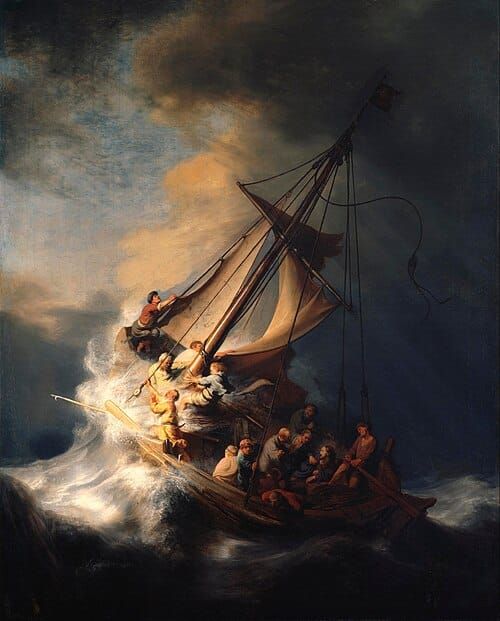
The Sleeping Lord and the Waking Soul
📖 Daily Scripture
June 30, 2026 — Tuesday of the Thirteenth Week in Ordinary Time
Readings: Amos 3:1-8; 4:11-12 • Psalm 5:4b-6a, 6b-7, 8 • Matthew 8:23-27
There is a moment, known to every soul that has ventured upon the deep of this life, when the waters that bore us gently up begin without warning to rise against us, when the winds that filled our sails turn to fury, and the vessel we thought secure is swamped by waves we cannot master. The disciples knew that moment upon the Sea of Galilee, and we know it still: the sudden squall of grief, the slow flood of anxiety, the tempest of temptation that breaks upon us when we are least prepared. And in that hour the soul cries out, as they cried, "Lord, save us! We are perishing!" — believing, and yet half-doubting; calling upon Him, and yet secretly persuaded that He has forgotten us, that He sleeps while we drown.
Yet it is precisely here that the Gospel turns our fear inside out. For the Lord did not rebuke the storm before He rebuked the fear; He asked first, "Why are you terrified, O you of little faith?" The peril was never in the waters but in the heart that had let its faith fall asleep. So the ancient masters of the soul understood it. When Augustine looked upon this scene he saw not merely a wonder upon a lake but a parable enacted within us, and he counselled the trembling soul: "Christ is asleep in thee. Thou hast forgotten Christ. Rouse Him up then, call Christ to mind, let Christ awake in thee." The storm has no power to sink the vessel in which Christ is remembered; it has only the power to wake us, if we will let it, from the drowsy forgetfulness that is the true shipwreck.
And this is the hidden mercy that the prophet Amos presses upon a people grown comfortable and deaf. Through calamity and upheaval God had spoken to Israel as a lion roars in the forest, and still they had not returned to Him; and so the prophet’s terrible tenderness comes to its point: "Prepare to meet your God." The trumpet that frightens the city, the tempest that swamps the boat — these are not the absence of God but His summons, the voice by which He startles the sleeping soul awake. For nothing befalls us outside the reach of His governing love. The witness of Scripture is unanimous that the solicitude of divine providence is concrete and immediate, caring for all things, from the least to the greatest, so that not a wave rises nor a wind blows but it is held within the hand that made the sea.
Here, then, is the lesson the soul must take down into the boat with it. Fear is not conquered by the calming of every storm, for the storms will come again; it is conquered by the waking of faith, by that childlike abandonment to the providence of our heavenly Father to which the Lord Himself invites us. To believe is not to be promised smooth water; it is to know Whom we have aboard, and to entrust to Him the helm we were never strong enough to hold. The soul that has learned this carries within it a stillness deeper than the sea’s unrest, the stillness of one who has understood that we must trust God in every circumstance, even in adversity, since "let nothing trouble you, let nothing frighten you; everything passes; God never changes; whoever has God wants for nothing; God alone is enough."
So let the winds rage and the waters climb. The One who slept in the stern was not indifferent but at peace, and His peace is offered to us. Wake Him within the heart, and the same voice that stilled the sea will speak its great calm into us; for with Christ aboard there is no perishing, and beyond every storm there waits the harbour of His unfailing love.
Lord Jesus, when the storms of this life rise against me and my faith lies sleeping, wake within my heart and still my fear. Teach me to trust Your providence in every circumstance, and to know that with You aboard I shall not perish. Let Your great calm reign within me, now and at the hour of my passing. Through Christ our Lord. Amen.
Sources & References
- "Lord, save us! We are perishing!" / "Why are you terrified, O you of little faith?" / "What sort of man is this, whom even the winds and the sea obey?" — Matthew 8:23-27 (Gospel)
- "Prepare to meet your God, O Israel." — Amos 3:1-8; 4:11-12 (First Reading)
- "Lead me in your justice, Lord." — Psalm 5:4b-6a, 6b-7, 8 (Responsorial Psalm)
- "Christ is asleep in thee. Thou hast forgotten Christ. Rouse Him up then, call Christ to mind, let Christ awake in thee." — St. Augustine, Sermon 63 (on Matthew 8)
- "the solicitude of divine providence is concrete and immediate" — Catechism of the Catholic Church, 303
- "childlike abandonment to the providence of our heavenly Father" — Catechism of the Catholic Church, 305
- "let nothing trouble you, let nothing frighten you; everything passes; God never changes; whoever has God wants for nothing; God alone is enough" — St. Teresa of Jesus, quoted in Catechism of the Catholic Church, 227
- Papal insight tied to today’s Gospel: Pope Francis, Meditation at the Extraordinary Urbi et Orbi Moment of Prayer, 27 March 2020 ("Why are you afraid? Have you no faith?"). Note: today’s Vatican News "Word of the Day" (30 June 2026) was not yet published when this was prepared; this well-attested papal meditation on the same storm Gospel is used in its place.
El Señor que duerme y el alma que despierta
📖 Sagrada Escritura Diaria
30 de junio de 2026 — Martes de la XIII semana del Tiempo ordinario
Lecturas: Amós 3, 1-8; 4, 11-12 • Salmo 5, 5-6. 7-8 • Mateo 8, 23-27
Hay un momento, conocido por toda alma que se ha aventurado en lo hondo de esta vida, en que las aguas que suavemente nos sostenían comienzan sin aviso a alzarse contra nosotros, en que los vientos que henchían nuestras velas se vuelven furia, y la barca que creíamos segura queda cubierta por olas que no podemos dominar. Los discípulos conocieron ese momento sobre el mar de Galilea, y nosotros lo conocemos todavía: la repentina ráfaga del dolor, la lenta inundación de la angustia, la tempestad de la tentación que rompe sobre nosotros cuando menos preparados estamos. Y en esa hora el alma clama, como ellos clamaron: "Señor, ¡sálvanos, que perecemos!" — creyendo, y a la vez dudando a medias; invocándolo, y a la vez secretamente persuadida de que se ha olvidado de nosotros, de que duerme mientras nos hundimos.
Mas es precisamente aquí donde el Evangelio vuelve del revés nuestro temor. Pues el Señor no reprendió la tormenta antes de reprender el miedo; preguntó primero: "¿Por qué tienen miedo, hombres de poca fe?" El peligro nunca estuvo en las aguas, sino en el corazón que había dejado dormir su fe. Así lo comprendieron los antiguos maestros del alma. Cuando Agustín contempló esta escena, no vio meramente un prodigio sobre un lago, sino una parábola obrada dentro de nosotros, y aconsejó al alma temblorosa: "Cristo duerme en ti. Te has olvidado de Cristo. Despiértalo, pues; recuerda a Cristo, deja que Cristo despierte en ti." La tormenta no tiene poder para hundir la barca en que se recuerda a Cristo; sólo tiene el poder de despertarnos, si se lo permitimos, del soñoliento olvido que es el verdadero naufragio.
Y ésta es la misericordia oculta que el profeta Amós apremia sobre un pueblo vuelto cómodo y sordo. Por la calamidad y el trastorno había hablado Dios a Israel como ruge el león en la selva, y aun así no se habían vuelto a Él; y así la terrible ternura del profeta llega a su punto: "prepárate, Israel, a comparecer ante tu Dios." La trompeta que alarma a la ciudad, la tempestad que cubre la barca — no son la ausencia de Dios, sino su llamada, la voz con que sobresalta y despierta al alma dormida. Pues nada nos sucede fuera del alcance de su amor que todo lo gobierna. El testimonio de la Escritura es unánime: la solicitud de la divina providencia es concreta e inmediata; tiene cuidado de todo, de las cosas más pequeñas hasta los grandes acontecimientos, de modo que no se levanta una ola ni sopla un viento que no esté sostenido en la mano que hizo el mar.
He aquí, pues, la lección que el alma ha de llevar consigo dentro de la barca. El miedo no se vence con la calma de cada tormenta, porque las tormentas volverán; se vence con el despertar de la fe, con aquel abandono filial en la providencia del Padre celestial al que el Señor mismo nos invita. Creer no es la promesa de aguas mansas; es saber a Quién llevamos a bordo, y confiarle el timón que nunca fuimos lo bastante fuertes para sostener. El alma que ha aprendido esto lleva dentro de sí una quietud más honda que la inquietud del mar, la quietud de quien ha entendido que hemos de confiar en Dios en toda circunstancia, incluso en la adversidad, pues "nada te turbe, nada te espante; todo se pasa, Dios no se muda; quien a Dios tiene nada le falta; sólo Dios basta."
Que rujan, pues, los vientos y suban las aguas. Aquel que dormía en la popa no era indiferente, sino que estaba en paz, y su paz se nos ofrece. Despiértalo dentro del corazón, y la misma voz que aquietó el mar dirá su gran calma dentro de nosotros; pues con Cristo a bordo no hay perdición, y más allá de toda tormenta aguarda el puerto de su amor que no falla.
Señor Jesús, cuando las tormentas de esta vida se alcen contra mí y mi fe yazga dormida, despierta dentro de mi corazón y aquieta mi temor. Enséñame a confiar en tu providencia en toda circunstancia, y a saber que contigo a bordo no pereceré. Reine tu gran calma dentro de mí, ahora y en la hora de mi tránsito. Por Jesucristo nuestro Señor. Amén.
Fuentes y referencias
- "Señor, ¡sálvanos, que perecemos!" / "¿Por qué tienen miedo, hombres de poca fe?" / "¿Quién es éste, a quien hasta los vientos y el mar obedecen?" — Mateo 8, 23-27 (Evangelio)
- "prepárate, Israel, a comparecer ante tu Dios" — Amós 3, 1-8; 4, 11-12 (Primera lectura)
- "Enséñame, Señor, tu santidad." — Salmo 5, 5-6. 7-8 (Salmo responsorial)
- "Cristo duerme en ti. Te has olvidado de Cristo. Despiértalo, pues; recuerda a Cristo, deja que Cristo despierte en ti." — San Agustín, Sermón 63 (sobre Mateo 8)
- "la solicitud de la divina providencia es concreta e inmediata" — Catecismo de la Iglesia Católica, 303
- "abandono filial en la providencia del Padre celestial" — Catecismo de la Iglesia Católica, 305
- "nada te turbe, nada te espante; todo se pasa, Dios no se muda; quien a Dios tiene nada le falta; sólo Dios basta" — Santa Teresa de Jesús, citada en el Catecismo de la Iglesia Católica, 227
- Aporte papal ligado al Evangelio de hoy: Papa Francisco, Meditación en el Momento extraordinario de oración Urbi et Orbi, 27 de marzo de 2020 ("¿Por qué tenéis miedo? ¿Aún no tenéis fe?"). Nota: la "Palabra del día" de Vatican News del 30 de junio de 2026 aún no estaba publicada al prepararse; se usa en su lugar esta conocida meditación papal sobre el mismo Evangelio de la tempestad.