
📖 Daily Scripture
Saturday, October 24, 2026 — Saturday of the Twenty-ninth Week in Ordinary Time
Readings: Ephesians 4:7-16 • Psalm 122:1-2, 3-4ab, 4cd-5 • Luke 13:1-9
There are moments when the report of some calamity reaches the soul, and almost before it is aware of what it does, it begins to reason about the fault of those who suffered. So it was with those who came to our Lord bearing news of the Galileans whom Pilate had slain at their sacrifices, and so again with the eighteen upon whom the tower at Siloam fell. Christ does not satisfy their curiosity, nor does He consent to their quiet assumption that misfortune is the measure of guilt. He turns the question, gently but without appeal, back upon the questioners themselves: "if you do not repent, you will all perish as they did." The soul that would sit in judgment over another's ruin is summoned instead to look upon its own unfruitfulness.
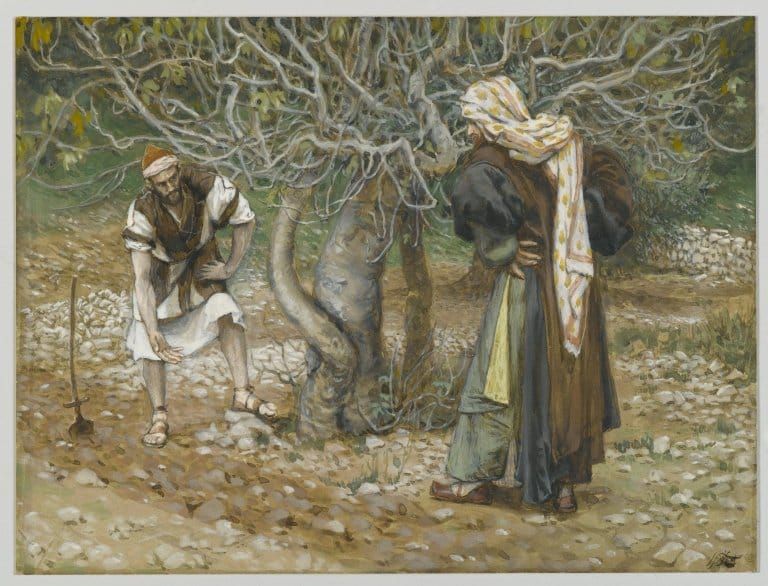
This is the meaning of the parable that follows. For three years together the owner comes in search of fruit and finds none, and his question carries a severity that ought not to be softened: "Why should it exhaust the soil?" A life may be outwardly blameless and yet occupy its place in the garden of God without yielding anything, drawing continually upon grace, upon the sacraments, upon the patience and the prayers of others, and returning nothing. Yet the gardener intercedes: "Sir, leave it for this year also, and I shall cultivate the ground around it and fertilize it." Here is the whole economy of mercy in a single sentence: a reprieve that is not indifference, a delay that is filled with labour, a love that digs about the roots of a barren thing because it has not yet despaired of it. Pope Francis, reflecting upon this parable, observed that "God is patient and offers us the possibility to change and make progress on the path towards good," and in the same breath he warned that "the possibility of conversion is not unlimited."
The lesson, then, is twofold, and the soul must hold both halves of it together. It must refuse that secret pharisaism which reads the sufferings of others as verdicts upon them; and it must refuse equally that presumption which reads the patience of God as a permission to postpone. The year that is granted is this year; the cultivation that is offered is the grace of today. The Church describes what is asked as "a radical reorientation of our whole life, a return, a conversion to God with all our heart," and she is careful to add that it is undertaken "with hope in God's mercy and trust in the help of his grace." It is not the anxious striving of a tree to justify itself, but the yielding of the ground to the hand that tends it, for "conversion is first of all a work of the grace of God who makes our hearts return to him," and "God gives us the strength to begin anew."
And what fruit is sought? Saint Paul gives the answer in the first reading. The fruit of a converted life is not a private ornament but a contribution to the growth of the one Body of Christ, which, "joined and held together by every supporting ligament, with the proper functioning of each part, brings about the Body's growth and builds itself up in love." The Apostle reminds the soul that "grace was given to each of us according to the measure of Christ's gift," and to withhold that grace is to leave some ligament slack in the Body. "The body's unity does not do away with the diversity of its members"; the particular fruit asked of one soul may be asked of no other. The barren tree is the soul content to be "tossed by waves and swept along by every wind of teaching," never rooted and never yielding; the fruitful tree is the soul that learns, in the Apostle's words, to be "living the truth in love."
Saint Clement of Rome, writing to the Corinthians when the age of the Apostles was scarcely past, pointed to the one source from which such fruit can spring: "Let us fix our eyes on Christ's blood and understand how precious it is to his Father, for, poured out for our salvation it has brought to the whole world the grace of repentance." That precious blood is the true nourishment laid about the roots of every barren life. The Gardener who pleads for one more year is Himself the One who was laid in the earth and rose again to bear fruit for all. The soul, therefore, need not dread the owner's coming, so long as it does not despise the gardener's care. There is still time; there is still grace; and the psalmist's gladness may yet become its own: "I rejoiced because they said to me, 'We will go up to the house of the LORD.'"
Merciful Father, who in Your patience have granted me yet another year, do not let me waste it. Let Your Son, the patient Gardener, loosen the hardened ground of my heart and nourish its roots with His precious blood, and teach me to bear within His Body the fruit of love. Through Christ our Lord. Amen.
Sources & References
- Readings for Saturday of the Twenty-ninth Week in Ordinary Time (Lectionary 478) — USCCB, bible.usccb.org/bible/readings/102426.cfm
- "if you do not repent, you will all perish as they did" — Luke 13:3, 5
- "Why should it exhaust the soil?" — Luke 13:7
- "Sir, leave it for this year also, and I shall cultivate the ground around it and fertilize it" — Luke 13:8
- "grace was given to each of us according to the measure of Christ's gift" — Ephesians 4:7
- "tossed by waves and swept along by every wind of teaching" — Ephesians 4:14
- "living the truth in love" — Ephesians 4:15
- "joined and held together by every supporting ligament … builds itself up in love" — Ephesians 4:16
- "I rejoiced because they said to me, 'We will go up to the house of the LORD.'" — Psalm 122:1
- "a radical reorientation of our whole life, a return, a conversion to God with all our heart" and "with hope in God's mercy and trust in the help of his grace" — Catechism of the Catholic Church, 1431
- "conversion is first of all a work of the grace of God who makes our hearts return to him" and "God gives us the strength to begin anew" — Catechism of the Catholic Church, 1432
- "The body's unity does not do away with the diversity of its members" — Catechism of the Catholic Church, 791
- "Let us fix our eyes on Christ's blood … the grace of repentance" — St. Clement of Rome, Letter to the Corinthians 7, 4 (as quoted in Catechism of the Catholic Church, 1432)
- "God is patient and offers us the possibility to change and make progress on the path towards good" and "the possibility of conversion is not unlimited" — Pope Francis, Angelus, Third Sunday of Lent, 24 March 2019 (vatican.va). Vatican News "Word of the Day" for 24 October 2026 was not yet published at the time of writing, so this earlier papal teaching on today's Gospel is used.
Un año más: la paciencia del viñador
📖 Sagrada Escritura Diaria
Sábado, 24 de octubre de 2026 — Sábado de la XXIX semana del Tiempo ordinario
Lecturas: Efesios 4, 7. 11-16 • Salmo 121, 1-2. 3-4ab. 4cd-5 • Lucas 13, 1-9
Hay momentos en que la noticia de alguna calamidad llega al alma y, casi antes de advertir lo que hace, comienza a razonar sobre la culpa de quienes la padecieron. Así sucedió con aquellos que fueron a ver al Señor para contarle lo de los galileos a quienes Pilato había mandado matar mientras ofrecían sus sacrificios, y así también con los dieciocho que murieron aplastados por la torre de Siloé. Cristo no satisface su curiosidad, ni consiente en la tácita suposición de que la desgracia sea la medida de la culpa. Devuelve la pregunta, con suavidad pero sin apelación, a quienes la hacían: "si ustedes no se arrepienten, perecerán de manera semejante". El alma que quisiera erigirse en juez de la ruina ajena es llamada, en cambio, a contemplar su propia esterilidad.
Tal es el sentido de la parábola que sigue. Durante tres años seguidos el dueño viene a buscar fruto y no lo encuentra, y su pregunta encierra una severidad que no conviene suavizar: "¿Para qué ocupa la tierra inútilmente?". Una vida puede ser exteriormente irreprochable y, sin embargo, ocupar su lugar en el huerto de Dios sin dar nada, alimentándose sin cesar de la gracia, de los sacramentos, de la paciencia y de las oraciones de otros, y sin devolver nada. Pero el viñador intercede: "Señor, déjala todavía este año; voy a aflojar la tierra alrededor y a echarle abono, para ver si da fruto". He aquí toda la economía de la misericordia en una sola frase: una prórroga que no es indiferencia, una espera llena de trabajo, un amor que cava en torno a las raíces de algo estéril porque todavía no ha desesperado de ello. El Papa Francisco, meditando esta parábola, observó que "Dios tiene paciencia y nos ofrece la posibilidad de cambiar y avanzar por el camino del bien", y en el mismo aliento advirtió que "la posibilidad de conversión no es ilimitada".
La lección, entonces, es doble, y el alma debe sostener juntas ambas mitades. Debe rechazar ese fariseísmo secreto que lee los sufrimientos ajenos como sentencias contra quienes los padecen; y debe rechazar igualmente esa presunción que lee la paciencia de Dios como un permiso para aplazar. El año concedido es este año; el cultivo que se ofrece es la gracia de hoy. La Iglesia describe lo que se pide como "una reorientación radical de toda la vida, un retorno, una conversión a Dios con todo nuestro corazón", y cuida de añadir que se emprende "con la esperanza de la misericordia divina y la confianza en la ayuda de su gracia". No es el esfuerzo ansioso de un árbol por justificarse a sí mismo, sino el abandono de la tierra a la mano que la cultiva, porque "la conversión es primeramente una obra de la gracia de Dios que hace volver a Él nuestros corazones", y "Dios es quien nos da la fuerza para comenzar de nuevo".
¿Y qué fruto se busca? San Pablo da la respuesta en la primera lectura. El fruto de una vida convertida no es un adorno privado, sino una aportación al crecimiento del único Cuerpo de Cristo, del cual "todo el cuerpo recibe su organización, su cohesión y su vida, según la actividad propia de cada una de las partes, y así el cuerpo va creciendo y construyéndose por medio del amor". El Apóstol recuerda al alma que "cada uno de nosotros ha recibido la gracia en la medida en que Cristo se la ha dado", y retener esa gracia es dejar flojo algún ligamento del Cuerpo. "La unidad del cuerpo no ha abolido la diversidad de los miembros"; el fruto particular que se pide a un alma quizá no se pida a ninguna otra. El árbol estéril es el alma que se conforma con ser como aquellos niños "zarandeados por las olas y llevados de un lado para otro por el viento de cualquier doctrina", sin raíces y sin fruto; el árbol fecundo es el alma que aprende, con palabras del Apóstol, a crecer "viviendo sinceramente en el amor".
San Clemente Romano, escribiendo a los corintios cuando apenas había pasado la edad de los Apóstoles, señaló la única fuente de la que puede brotar tal fruto: "Tengamos los ojos fijos en la sangre de Cristo y comprendamos cuán preciosa es a su Padre, porque, habiendo sido derramada para nuestra salvación, ha conseguido para el mundo entero la gracia del arrepentimiento". Esa sangre preciosa es el verdadero abono depositado en torno a las raíces de toda vida estéril. El Viñador que implora un año más es Él mismo quien fue sepultado en la tierra y resucitó para dar fruto para todos. El alma, por tanto, no tiene por qué temer la venida del dueño, con tal de que no desprecie el cuidado del viñador. Todavía hay tiempo; todavía hay gracia; y la alegría del salmista puede llegar a ser la suya: "¡Qué alegría sentí, cuando me dijeron: 'Vayamos a la casa del Señor'!".
Padre misericordioso, que en tu paciencia me has concedido todavía un año más, no permitas que lo desperdicie. Que tu Hijo, el Viñador paciente, afloje la tierra endurecida de mi corazón y alimente sus raíces con su sangre preciosa, y enséñame a dar dentro de su Cuerpo el fruto del amor. Por Jesucristo nuestro Señor. Amén.
Fuentes y referencias
- Lecturas del Sábado de la XXIX semana del Tiempo ordinario (Leccionario 478) — USCCB, bible.usccb.org/es/bible/lecturas/102426.cfm (texto del Leccionario de la Conferencia Episcopal Mexicana)
- "si ustedes no se arrepienten, perecerán de manera semejante" — Lucas 13, 3. 5
- "¿Para qué ocupa la tierra inútilmente?" — Lucas 13, 7
- "Señor, déjala todavía este año; voy a aflojar la tierra alrededor y a echarle abono, para ver si da fruto" — Lucas 13, 8
- "Cada uno de nosotros ha recibido la gracia en la medida en que Cristo se la ha dado" — Efesios 4, 7
- "zarandeados por las olas y llevados de un lado para otro por el viento de cualquier doctrina" — Efesios 4, 14
- "viviendo sinceramente en el amor" — Efesios 4, 15
- "todo el cuerpo recibe su organización, su cohesión y su vida … construyéndose por medio del amor" — Efesios 4, 16
- "¡Qué alegría sentí, cuando me dijeron: 'Vayamos a la casa del Señor'!" — Salmo 121, 1
- "una reorientación radical de toda la vida, un retorno, una conversión a Dios con todo nuestro corazón" y "con la esperanza de la misericordia divina y la confianza en la ayuda de su gracia" — Catecismo de la Iglesia Católica, 1431
- "la conversión es primeramente una obra de la gracia de Dios que hace volver a Él nuestros corazones" y "Dios es quien nos da la fuerza para comenzar de nuevo" — Catecismo de la Iglesia Católica, 1432
- "La unidad del cuerpo no ha abolido la diversidad de los miembros" — Catecismo de la Iglesia Católica, 791
- "Tengamos los ojos fijos en la sangre de Cristo … la gracia del arrepentimiento" — San Clemente Romano, Carta a los Corintios 7, 4 (citado en el Catecismo de la Iglesia Católica, 1432)
- "Dios tiene paciencia y nos ofrece la posibilidad de cambiar y avanzar por el camino del bien" y "la posibilidad de conversión no es ilimitada" — Papa Francisco, Ángelus, III Domingo de Cuaresma, 24 de marzo de 2019 (vatican.va). La "Palabra del día" de Vatican News del 24 de octubre de 2026 aún no estaba publicada al momento de redactar, por lo que se emplea esta enseñanza papal anterior sobre el Evangelio de hoy.