
📖 Daily Scripture
Saturday, August 15, 2026 — Solemnity of the Assumption of the Blessed Virgin Mary (Mass during the Day)
Readings: Revelation 11:19a; 12:1-6a, 10ab • Psalm 45:10, 11, 12, 16 • 1 Corinthians 15:20-27 • Luke 1:39-56
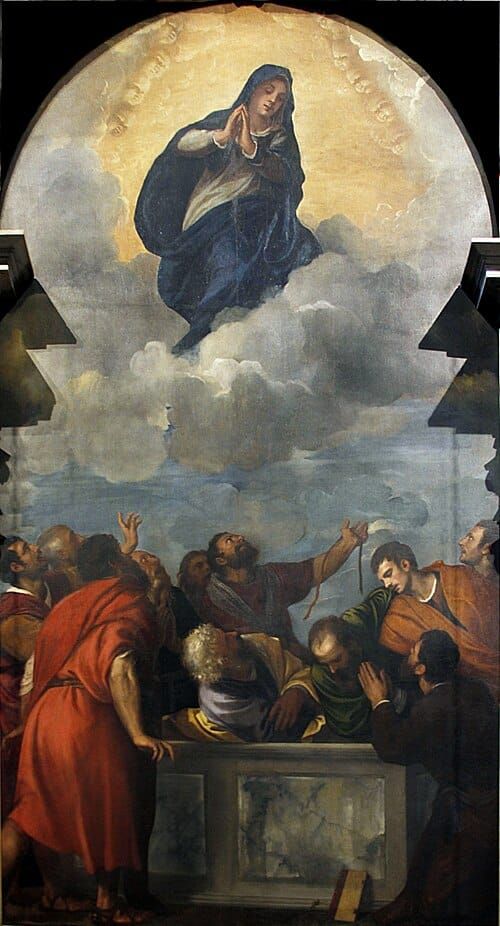
The vision given to John opens with a door and a disclosure: "God's temple in heaven was opened, and the ark of his covenant could be seen in the temple." For centuries the ark had been lost to Israel — the gold-covered chest that carried the tablets of the covenant, the vessel so holy that no unclean hand might touch it. And now, at the summit of revelation, the ark is seen again, not on earth but in heaven; and in the very next breath the seer beholds "a woman clothed with the sun, with the moon under her feet, and on her head a crown of twelve stars." The Church has never thought the sequence accidental. She who carried in her body not tablets of stone but the living Word, whose flesh was the first tabernacle of God among men, is herself the ark; and on this day the Church contemplates that ark carried up, whole and incorrupt, into the temple from which it came.
The psalm supplies the picture's court and ceremony: "The queen takes her place at your right hand in gold of Ophir." And St. Paul supplies its logic. "Christ has been raised from the dead, the firstfruits of those who have fallen asleep... in Christ shall all be brought to life, but each one in proper order." The Assumption is not a private privilege detached from us; it is the proper order of the harvest already begun. As the Catechism teaches, the Immaculate Virgin, "when the course of her earthly life was finished, was taken up body and soul into heavenly glory, and exalted by the Lord as Queen over all things"; and her Assumption "is a singular participation in her Son's Resurrection and an anticipation of the resurrection of other Christians." What grace has done in her, grace intends, in its own order, to do in every member of her Son.
Yet the Gospel the Church reads today is not a scene of enthronement but of a girl hurrying through hill country to serve her elderly kinswoman. This is the divine irony the soul must not miss. The one whom heaven crowns is the one who called herself lowly: "My soul proclaims the greatness of the Lord... for he has looked with favor on his lowly servant." The Magnificat is the secret of the Assumption sung in advance: "He has cast down the mighty from their thrones, and has lifted up the lowly." God exalts nothing but what is humble, for nothing else leaves Him room. And Elizabeth names the root of that humility: "Blessed are you who believed that what was spoken to you by the Lord would be fulfilled." Mary's glory began not in being spared sorrow — a sword would pierce her — but in believing God's word through every darkness until it was fulfilled in her very flesh.
When Pius XII defined the dogma in 1950, he pronounced "that the Immaculate Mother of God, the ever Virgin Mary, having completed the course of her earthly life, was assumed body and soul into heavenly glory." In doing so he gathered up the voice of the ancient Church, above all St. John Damascene: "It was fitting that she, who had kept her virginity intact in childbirth, should keep her own body free from all corruption even after death... It was fitting that God's Mother should possess what belongs to her Son." Fittingness is the language of love: the Son, who could honor His mother perfectly, did.
The moral lesson of this feast falls upon the body and upon hope. In an age tempted to treat the body as a tool, a burden, or a possession, the Assumption declares it destined for glory: what rose in Christ and was assumed in Mary is the same clay we carry to prayer and to work this morning. And the road to that glory is the Magnificat's road — lowliness, service, and stubborn faith that the promise will be kept. The Catechism says of Mary in glory that she "is the image and beginning of the Church as it is to be perfected in the world to come," shining "a sign of certain hope and comfort to the pilgrim People of God." The soul that walks today in humility does not walk toward the grave; it walks toward the open temple, where the ark has already entered, and where a Mother waits.
Lord, You have shown me in Your Mother where my own body and soul are destined, and by what road: the road of the lowly. Teach me to believe, as she believed, that what You have spoken to me will be fulfilled; let me magnify You in service today and hope in You through every sorrow, until You bring me whole into Your presence. Through Christ our Lord. Amen.
Sources & References
- "God's temple in heaven was opened, and the ark of his covenant could be seen" / "a woman clothed with the sun, with the moon under her feet, and on her head a crown of twelve stars" — Revelation 11:19a; 12:1 (First Reading, Lectionary 622, USCCB)
- "The queen takes her place at your right hand in gold of Ophir" — Psalm 45:10 (Responsorial Psalm)
- "Christ has been raised from the dead, the firstfruits of those who have fallen asleep" / "each one in proper order" — 1 Corinthians 15:20, 23 (Second Reading)
- "My soul proclaims the greatness of the Lord" / "He has cast down the mighty from their thrones, and has lifted up the lowly" / "Blessed are you who believed" — Luke 1:39-56 (Gospel)
- "When the course of her earthly life was finished, was taken up body and soul into heavenly glory" / "a singular participation in her Son's Resurrection and an anticipation of the resurrection of other Christians" — Catechism of the Catholic Church, 966 (quoting Lumen Gentium 59; the paragraph also quotes the Byzantine Troparion of the Dormition)
- "The image and beginning of the Church as it is to be perfected in the world to come" / "a sign of certain hope and comfort to the pilgrim People of God" — Catechism of the Catholic Church, 972 (quoting Lumen Gentium 68)
- "That the Immaculate Mother of God, the ever Virgin Mary, having completed the course of her earthly life, was assumed body and soul into heavenly glory" — Pope Pius XII, Apostolic Constitution Munificentissimus Deus, 1 November 1950, §44
- "It was fitting that she, who had kept her virginity intact in childbirth, should keep her own body free from all corruption even after death... It was fitting that God's Mother should possess what belongs to her Son" — St. John Damascene, Homily II on the Dormition, as cited in Munificentissimus Deus §21
- Papal note: today's Vatican News "Word of the Day" was not yet published at time of writing; Pope Leo XIV was celebrating the Assumption Mass at Castel Gandolfo this morning
- Daily readings: USCCB, bible.usccb.org, August 15, 2026 (Mass during the Day)
El Arca en el templo del cielo
📖 Sagrada Escritura Diaria
Sábado 15 de agosto de 2026 — Solemnidad de la Asunción de la Santísima Virgen María (Misa del día)
Lecturas: Apocalipsis 11, 19; 12, 1-6. 10 • Salmo 44, 10bc. 11. 12ab. 16 • 1 Corintios 15, 20-27 • Lucas 1, 39-56
La visión concedida a Juan se abre con una puerta y una revelación: "Se abrió el templo de Dios en el cielo y dentro de él se vio el arca de la alianza." Durante siglos el arca había estado perdida para Israel — el cofre revestido de oro que llevaba las tablas de la alianza, el vaso tan santo que ninguna mano impura podía tocarlo. Y ahora, en la cumbre de la revelación, el arca vuelve a verse, no en la tierra sino en el cielo; y en el aliento siguiente el vidente contempla "una mujer envuelta por el sol, con la luna bajo sus pies y con una corona de doce estrellas en la cabeza". La Iglesia nunca ha creído casual esta secuencia. La que llevó en su cuerpo no tablas de piedra sino la Palabra viva, cuya carne fue el primer tabernáculo de Dios entre los hombres, es ella misma el arca; y en este día la Iglesia contempla esa arca elevada, íntegra e incorrupta, al templo del que procedía.
El salmo aporta la corte y la ceremonia del cuadro: "De pie, a tu derecha, está la reina, enjoyada con oro de Ofir." Y san Pablo aporta su lógica. "Cristo resucitó, y resucitó como la primicia de todos los muertos... en Cristo todos volverán a la vida, pero cada uno en su orden." La Asunción no es un privilegio privado desligado de nosotros; es el orden propio de la cosecha ya comenzada. Como enseña el Catecismo, la Virgen Inmaculada, "terminado el curso de su vida en la tierra, fue asunta en cuerpo y alma a la gloria del cielo y enaltecida por Dios como Reina del universo"; y su Asunción "constituye una participación singular en la Resurrección de su Hijo y una anticipación de la resurrección de los demás cristianos". Lo que la gracia ha hecho en ella, la gracia se propone hacerlo, en su propio orden, en cada miembro de su Hijo.
Sin embargo, el Evangelio que la Iglesia lee hoy no es una escena de entronización, sino la de una muchacha que atraviesa presurosa la montaña para servir a su anciana parienta. Ésta es la ironía divina que el alma no debe pasar por alto. Aquella a quien el cielo corona es la que se llamó a sí misma humilde: "Mi alma glorifica al Señor... porque puso sus ojos en la humildad de su esclava." El Magníficat es el secreto de la Asunción cantado por adelantado: "Destronó a los potentados y exaltó a los humildes." Dios no exalta sino lo humilde, porque sólo lo humilde le deja sitio. E Isabel nombra la raíz de esa humildad: "Dichosa tú, que has creído, porque se cumplirá cuanto te fue anunciado de parte del Señor." La gloria de María no comenzó en verse libre del dolor — una espada la atravesaría — sino en creer la palabra de Dios a través de toda oscuridad, hasta verla cumplida en su propia carne.
Cuando Pío XII definió el dogma en 1950, pronunció "que la Inmaculada Madre de Dios, siempre Virgen María, terminado el curso de su vida terrena, fue asunta en cuerpo y alma a la gloria celestial". Al hacerlo recogía la voz de la Iglesia antigua, sobre todo la de san Juan Damasceno: "Era conveniente que aquella que en el parto había conservado intacta su virginidad, conservase también su cuerpo libre de toda corrupción después de la muerte... Era conveniente que la Madre de Dios poseyera lo que pertenece a su Hijo." La conveniencia es el lenguaje del amor: el Hijo, que podía honrar perfectamente a su Madre, lo hizo.
La lección moral de esta fiesta recae sobre el cuerpo y sobre la esperanza. En una época tentada de tratar el cuerpo como herramienta, carga o posesión, la Asunción lo declara destinado a la gloria: lo que resucitó en Cristo y fue asunto en María es el mismo barro que esta mañana llevamos a la oración y al trabajo. Y el camino hacia esa gloria es el camino del Magníficat: humildad, servicio y una fe tenaz en que la promesa será cumplida. El Catecismo dice de María glorificada que "es la imagen y comienzo de la Iglesia que llegará a su plenitud en el siglo futuro", y que brilla ante el Pueblo de Dios en marcha "como señal de esperanza cierta y de consuelo". El alma que camina hoy en humildad no camina hacia el sepulcro; camina hacia el templo abierto, donde el arca ya ha entrado, y donde espera una Madre.
Señor, me has mostrado en tu Madre el destino de mi cuerpo y de mi alma, y por qué camino: el camino de los humildes. Enséñame a creer, como ella creyó, que se cumplirá cuanto me has anunciado; que hoy te glorifique en el servicio y espere en ti a través de todo dolor, hasta que me lleves entero a tu presencia. Por Jesucristo nuestro Señor. Amén.
Fuentes y referencias
- "Se abrió el templo de Dios en el cielo y dentro de él se vio el arca de la alianza" / "una mujer envuelta por el sol, con la luna bajo sus pies y con una corona de doce estrellas en la cabeza" — Apocalipsis 11, 19; 12, 1 (Primera lectura, Leccionario 622, USCCB en español)
- "De pie, a tu derecha, está la reina, enjoyada con oro de Ofir" — Salmo 44, 10 (Salmo responsorial, Leccionario de México)
- "Cristo resucitó, y resucitó como la primicia de todos los muertos" / "cada uno en su orden" — 1 Corintios 15, 20. 23 (Segunda lectura)
- "Mi alma glorifica al Señor" / "Destronó a los potentados y exaltó a los humildes" / "Dichosa tú, que has creído" — Lucas 1, 39-56 (Evangelio)
- "Terminado el curso de su vida en la tierra, fue asunta en cuerpo y alma a la gloria del cielo" / "constituye una participación singular en la Resurrección de su Hijo y una anticipación de la resurrección de los demás cristianos" — Catecismo de la Iglesia Católica, 966 (citando Lumen Gentium 59; el párrafo cita también el Tropario bizantino de la Dormición)
- "Es la imagen y comienzo de la Iglesia que llegará a su plenitud en el siglo futuro" / "señal de esperanza cierta y de consuelo" — Catecismo de la Iglesia Católica, 972 (citando Lumen Gentium 68)
- "Que la Inmaculada Madre de Dios, siempre Virgen María, terminado el curso de su vida terrena, fue asunta en cuerpo y alma a la gloria celestial" — Papa Pío XII, Constitución apostólica Munificentissimus Deus, 1 de noviembre de 1950, §44
- "Era conveniente que aquella que en el parto había conservado intacta su virginidad, conservase también su cuerpo libre de toda corrupción después de la muerte" — San Juan Damasceno, Homilía II sobre la Dormición, citado en Munificentissimus Deus §21 (traducción del texto inglés estándar)
- Nota papal: la "Palabra del día" de Vatican News de hoy aún no estaba publicada al momento de escribir; el Papa León XIV celebraba esta mañana la Misa de la Asunción en Castel Gandolfo
- Lecturas diarias: USCCB, bible.usccb.org/es, 15 de agosto de 2026 (Misa del día)