
📖 Daily Scripture
Friday, August 21, 2026 — Memorial of Saint Pius X, Pope
Readings: Ezekiel 37:1-14 • Psalm 107:2-3, 4-5, 6-7, 8-9 • Matthew 22:34-40
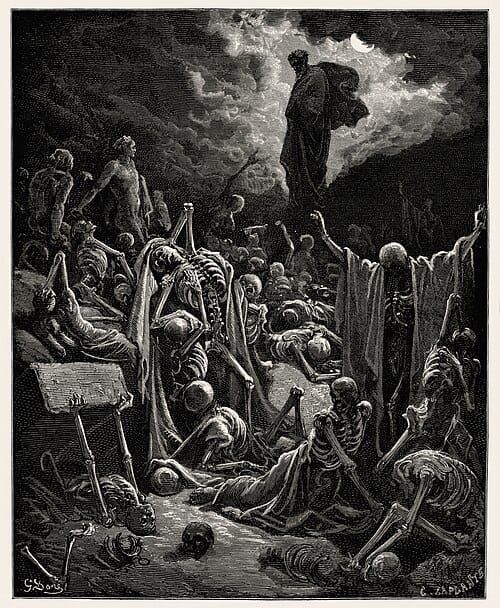
The prophet is not shown a battlefield in the heat of its struggle, nor a city in the hour of its fall, but something quieter and more terrible: a plain long emptied of its dead, where what remains has been bleached by many suns. He is made to walk among the bones in every direction, and the detail on which the Scripture insists is not their number but their dryness. There is a poverty deeper than want and a sorrow deeper than grief, and it is this: to have been living once, and to have forgotten what living was.
The soul that reads this vision honestly will not place itself among the spectators. Dryness of that kind rarely announces itself. It does not arrive as a decision to abandon God; it arrives as the slow evaporation of warmth from things that continue outwardly unchanged. Prayers are still said, and said correctly. Duties are still discharged, and discharged without complaint. Yet somewhere within, the marrow has gone out of them, and what was once offered out of love is now merely accomplished. A man may keep the whole of his religion and lose the whole of its life, and be the last to notice.
To such a soul God addresses a question rather than a rebuke. Can these bones come to life? It is a question the prophet is wise enough not to answer on his own authority: “Lord GOD, you alone know that.” Here is the first lesson of the vision, and it is a lesson in humility — the soul is not asked to raise itself. Every attempt to manufacture fervour by effort alone ends in a heap more discouraged than before. The bones do not knit themselves; they are knit. The breath does not rise from the plain; it comes from the four winds, which is to say, from God.
And what is that breath? The Church answers plainly: “God is Love and love is his first gift, containing all others.” Life, in the divine reckoning, is not merely animation but charity; and this is why the Gospel of the day is not a change of subject but the same subject brought to its point. The scholar of the law wishes to know which commandment is greatest, and he is told that the greatest is to love, and that the second is like it, and that on these two the whole law and the prophets depend. Not adorn — depend. Remove love, and the structure does not merely lose its beauty; it collapses into bones.
The moral lesson is therefore uncomfortably concrete. “Charity is the theological virtue by which we love God above all things for his own sake, and our neighbor as ourselves for the love of God.” That single definition rules out the two evasions the heart most prefers: loving God in a general way while quietly excluding one particular neighbour, and serving that neighbour out of temperament or convenience rather than for the love of God. “The practice of all the virtues is animated and inspired by charity.” Whatever is not so animated is bone. And each soul knows, without needing to search, the name of the person it has written off — the relative not spoken to, the colleague filed away as impossible, the offence rehearsed so often that it has become a possession. There the plain is driest. There the Spirit is asking to be let in.
It was by this, and not by argument, that the world first knew Christians at all: “See, they say, how they love one another.” And the love in question was never left undefined. Christ set the measure himself: “I give you a new commandment: that you love one another, just as I have loved you” — a love modelled on his own, patient, unenvious, not insisting on its own way, bearing all things. By it every soul is finally measured, for as one of the Fathers wrote, “The culmination of all our works is love. That is the end; for that we run, toward that we run; when we arrive at it, we shall rest.”
So the vision does not end in a plain of bones but in a vast army standing upright. What God promises, he performs. No dryness lies beyond the reach of that wind, and no soul that consents to be breathed upon remains long among the dead.
Lord, you alone know whether these bones of mine can live; I do not. Breathe into me the love I cannot manufacture, and let it reach the one person I have kept outside it. Teach me to love you above all things for your own sake, and my neighbour for love of you. Through Christ our Lord. Amen.
Sources & References
- “How dry they were!” — Ezekiel 37:1-14, First Reading (USCCB, 21 August 2026)
- “Lord GOD, you alone know that.” — Ezekiel 37:3
- “Give thanks to the Lord; his love is everlasting.” — Psalm 107:2-3, 4-5, 6-7, 8-9, Responsorial Psalm
- “You shall love the Lord, your God, with all your heart… The whole law and the prophets depend on these two commandments.” — Matthew 22:34-40, Gospel
- “God is Love and love is his first gift, containing all others.” — Catechism of the Catholic Church, 733
- “Charity is the theological virtue by which we love God above all things for his own sake, and our neighbor as ourselves for the love of God.” — Catechism of the Catholic Church, 1822
- “The practice of all the virtues is animated and inspired by charity.” — Catechism of the Catholic Church, 1827
- “See, they say, how they love one another.” — Tertullian, Apology, 39
- “The culmination of all our works is love. That is the end; for that we run, toward that we run; when we arrive at it, we shall rest.” — St. Augustine, In epistulam Ioannis tractatus, 10, 4; cited in Catechism of the Catholic Church, 1829
- “I give you a new commandment: that you love one another, just as I have loved you.” — John 13:34
- Papal commentary: St. John Paul II, General Audience, 31 August 1988 — Vatican News, “Word of the Day,” 21 August 2026
El aliento que levanta los huesos secos
📖 Sagrada Escritura Diaria
Viernes, 21 de agosto de 2026 — Memoria de San Pío X, papa
Lecturas: Ezequiel 37, 1-14 • Salmo 106, 2-3. 4-5. 6-7. 8-9 • Mateo 22, 34-40
Al profeta no se le muestra un campo de batalla en el ardor de su lucha, ni una ciudad en la hora de su caída, sino algo más callado y más terrible: una llanura vaciada hace mucho de sus muertos, donde lo que queda ha sido blanqueado por muchos soles. Se le hace dar vueltas entre los huesos en todas direcciones, y el detalle en que la Escritura insiste no es su número, sino su sequedad: “estaban completamente secos”. Hay una pobreza más honda que la indigencia y una tristeza más honda que el duelo, y es ésta: haber vivido una vez, y haber olvidado qué era vivir.
El alma que lea con honradez esta visión no se colocará entre los espectadores. Una sequedad así rara vez se anuncia. No llega como la decisión de abandonar a Dios; llega como la lenta evaporación del calor en cosas que por fuera siguen intactas. Las oraciones se siguen rezando, y se rezan correctamente. Los deberes se siguen cumpliendo, y se cumplen sin queja. Y sin embargo, en algún lugar interior, se les ha ido la médula, y lo que antes se ofrecía por amor ahora simplemente se ejecuta. Un hombre puede conservar entera su religión y perder entera su vida, y ser el último en advertirlo.
A un alma así Dios le dirige una pregunta antes que un reproche: “Hijo de hombre, ¿podrán acaso revivir estos huesos?” Es una pregunta que el profeta tiene la sabiduría de no responder por cuenta propia: “Señor, tú lo sabes”. He aquí la primera lección de la visión, y es lección de humildad: no se le pide al alma que se levante a sí misma. Todo intento de fabricar el fervor a fuerza de esfuerzo termina en un montón más desalentado que antes. Los huesos no se juntan solos; son juntados. El aliento no brota de la llanura; viene de los cuatro vientos, es decir, de Dios.
¿Y qué es ese aliento? La Iglesia responde con sencillez: “Dios es Amor y el Amor, que es el primer don, contiene todos los demás.” La vida, en la cuenta divina, no es mera animación sino caridad; y por eso el Evangelio del día no cambia de tema, sino que lleva el mismo tema a su punto. El doctor de la ley quiere saber cuál es el mandamiento más grande, y se le responde que el más grande es amar, y que el segundo es semejante a éste, y que “en estos dos mandamientos se fundan toda la ley y los profetas”. No dice que la adornen: dice que en ellos se funda. Quítese el amor, y la construcción no pierde solamente su hermosura: se desploma en huesos.
La lección moral resulta, por tanto, incómodamente concreta. “La caridad es la virtud teologal por la cual amamos a Dios sobre todas las cosas por Él mismo y a nuestro prójimo como a nosotros mismos por amor de Dios.” Esa sola definición excluye las dos evasiones que el corazón prefiere: amar a Dios en general mientras se excluye calladamente a un prójimo en particular, y servir a ese prójimo por temperamento o por conveniencia, y no por amor de Dios. “El ejercicio de todas las virtudes está animado e inspirado por la caridad.” Lo que no está así animado es hueso. Y cada alma sabe, sin necesidad de buscar, el nombre de la persona a la que ha dado por perdida: el pariente con quien ya no se habla, el compañero archivado como imposible, la ofensa repasada tantas veces que ha llegado a ser una posesión. Allí la llanura está más seca. Allí el Espíritu pide que se le deje entrar.
Por esto, y no por argumentos, conoció el mundo por primera vez a los cristianos: “Mirad —dicen— cómo se aman unos a otros”. Y el amor del que se trata nunca quedó sin definir. Cristo mismo puso la medida: “Un mandamiento nuevo os doy: que os améis unos a otros como yo os he amado” — un amor modelado sobre el suyo, paciente, sin envidia, que no busca su interés, que todo lo soporta. Por él se mide finalmente toda alma, pues como escribió uno de los Padres: “La culminación de todas nuestras obras es el amor. Ese es el fin; para conseguirlo, corremos; hacia él corremos; una vez llegados, en él reposamos”.
Por eso la visión no termina en una llanura de huesos, sino en una multitud innumerable puesta en pie. Lo que Dios promete, lo cumple. Ninguna sequedad queda fuera del alcance de ese viento, y ningún alma que consienta en ser soplada permanece mucho tiempo entre los muertos.
Señor, tú solo sabes si estos huesos míos pueden revivir; yo no lo sé. Infunde en mí el amor que no puedo fabricar, y haz que alcance a la única persona que he dejado fuera de él. Enséñame a amarte a ti sobre todas las cosas por ti mismo, y a mi prójimo por amor tuyo. Por Jesucristo nuestro Señor. Amén.
Fuentes y referencias
- “Estaban completamente secos.” — Ezequiel 37, 1-14, Primera lectura (USCCB, 21 de agosto de 2026)
- “Señor, tú lo sabes.” — Ezequiel 37, 3
- “Demos gracias a Dios, porque nos ama.” — Salmo 106, 2-3. 4-5. 6-7. 8-9, Salmo responsorial
- “Amarás al Señor, tu Dios, con todo tu corazón… En estos dos mandamientos se fundan toda la ley y los profetas.” — Mateo 22, 34-40, Evangelio
- “Dios es Amor y el Amor, que es el primer don, contiene todos los demás.” — Catecismo de la Iglesia Católica, 733
- “La caridad es la virtud teologal por la cual amamos a Dios sobre todas las cosas por Él mismo y a nuestro prójimo como a nosotros mismos por amor de Dios.” — Catecismo de la Iglesia Católica, 1822
- “El ejercicio de todas las virtudes está animado e inspirado por la caridad.” — Catecismo de la Iglesia Católica, 1827
- “Mirad —dicen— cómo se aman unos a otros.” — Tertuliano, Apologético, 39
- “La culminación de todas nuestras obras es el amor. Ese es el fin; para conseguirlo, corremos; hacia él corremos; una vez llegados, en él reposamos.” — San Agustín, In epistulam Ioannis tractatus, 10, 4; citado en el Catecismo de la Iglesia Católica, 1829
- “Un mandamiento nuevo os doy: que os améis unos a otros como yo os he amado.” — Juan 13, 34
- Comentario papal: San Juan Pablo II, Audiencia General, 31 de agosto de 1988 — Vatican News, “Palabra del día”, 21 de agosto de 2026