
📖 Daily Scripture
Sunday, October 25, 2026 — Thirtieth Sunday in Ordinary Time
Readings: Exodus 22:20-26 • Psalm 18:2-3, 3-4, 47, 51 • 1 Thessalonians 1:5c-10 • Matthew 22:34-40
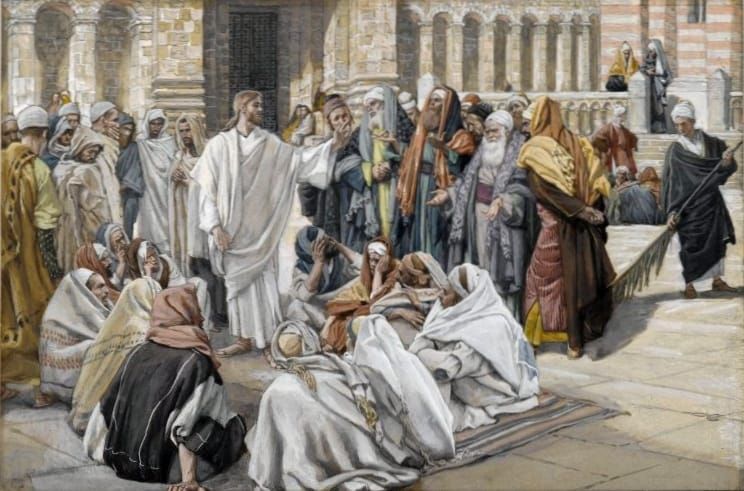
A scholar of the law comes to Christ not to learn but to test; and he asks which commandment is the greatest, as though God’s law were a ladder whose lower rungs might be quietly neglected. The answer he receives is at once the oldest thing in Israel and the newest thing in the world: “You shall love the Lord, your God, with all your heart, with all your soul, and with all your mind,” and the second, which is like it, “You shall love your neighbor as yourself.” Our Lord does not choose between them. He binds them so closely that “the whole law and the prophets depend on these two commandments,” and the soul which would grasp the one while letting go of the other soon discovers that it holds neither.
It is fitting that the Church sets beside this Gospel a passage from Exodus so plain and particular that it seems at first to belong to another order of things. It speaks of the stranger, the widow, and the orphan, of money lent and interest demanded, of a poor man’s cloak taken in pledge. “If you take your neighbor’s cloak as a pledge, you shall return it to him before sunset; for this cloak of his is the only covering he has for his body. What else has he to sleep in?” The God who numbers the stars condescends to ask where a poor man will sleep tonight, and He gives a reason which ought to search every conscience: “If he cries out to me, I will hear him; for I am compassionate.”
Here, then, is the lesson which these readings press upon the soul. The love of God is not proved by the warmth of devotion alone, but by the cloak returned before the sun goes down — by the small, exact, and often inconvenient justice rendered to those who have no power to demand it. The Church teaches that charity is “the theological virtue by which we love God above all things for his own sake, and our neighbor as ourselves for the love of God”. St. Augustine saw this with great clearness. Though the love of God stands first in dignity, yet “in the order of doing, the love of our neighbor comes first”; and he gives the reason, that “by loving your neighbor you purge your eye for seeing God.”
The heart readily supplies its excuses, yet the law of Sinai cuts through them all, and St. John Chrysostom, preaching on the rich man and Lazarus, cuts deeper still: “Not to enable the poor to share in our goods is to steal from them and deprive them of life. The goods we possess are not ours, but theirs.” Such words teach the soul that what it holds is held in trust, and that the works of mercy, which the Catechism calls “charitable actions by which we come to the aid of our neighbor in his spiritual and bodily necessities,” are not ornaments of the Christian life but its ordinary substance.
Yet there is a consolation hidden within the precept. Pope Benedict XVI, reflecting on this very commandment, wrote that “before being a command — love is not a command — it is a gift,” and that “love of God and love of neighbour are inseparable and are mutually related.” The soul is not asked to manufacture out of its own poverty a love it does not possess; it is asked to receive the love God has first poured out, and to let it pass through to the one who stands shivering at dusk. The Thessalonians, St. Paul says, “turned to God from idols to serve the living and true God”; and every soul that returns the cloak makes that same turning in miniature, away from the idol of its own security toward the God who hears the cry of the poor.
Nor is such service a burden without reward. The psalmist could sing, “I love you, O LORD, my strength,” because he had learned that the God who commands mercy is Himself the soul’s rock, fortress, and deliverer. Let the soul, then, look each evening at the setting sun and ask what cloak it still holds that belongs to another; and in the very asking it will find not condemnation, but the gentle nearness of a Father whose whole law is love, and whose love never sets.
Lord Jesus, who bound the love of God and the love of neighbor into a single law, teach me to give back before sunset what is not mine to keep. Open my eyes to the stranger, the widow, and the poor whom You set at my door, and purify my heart through mercy, that I may come at last to see Your face. Through Christ our Lord. Amen.
Sources & References
- “You shall love the Lord, your God, with all your heart…”; “You shall love your neighbor as yourself”; “The whole law and the prophets depend on these two commandments” — Matthew 22:34-40 (Gospel, NABRE Lectionary).
- “If you take your neighbor’s cloak as a pledge…”; “If he cries out to me, I will hear him; for I am compassionate” — Exodus 22:20-26 (First Reading).
- “I love you, O LORD, my strength” — Psalm 18:2-3, 3-4, 47, 51 (Responsorial Psalm).
- “Turned to God from idols to serve the living and true God” — 1 Thessalonians 1:5c-10 (Second Reading).
- “The theological virtue by which we love God above all things for his own sake, and our neighbor as ourselves for the love of God” — Catechism of the Catholic Church, 1822.
- “Charitable actions by which we come to the aid of our neighbor in his spiritual and bodily necessities” — Catechism of the Catholic Church, 2447.
- “Not to enable the poor to share in our goods is to steal from them… The goods we possess are not ours, but theirs” — St. John Chrysostom, Homilies on Lazarus 2, as quoted in the Catechism of the Catholic Church, 2446.
- “In the order of doing, the love of our neighbor comes first”; “By loving your neighbor you purge your eye for seeing God” — St. Augustine, Tractates on the Gospel of John, Tractate 17, 8 (NPNF translation).
- “Before being a command — love is not a command — it is a gift”; “Love of God and love of neighbour are inseparable and are mutually related” — Pope Benedict XVI, Angelus, November 4, 2012 (featured in Vatican News “Word of the Day,” October 25, 2026).
El manto devuelto antes del ocaso
📖 Sagrada Escritura Diaria
Domingo, 25 de octubre de 2026 — XXX Domingo Ordinario
Lecturas: Éxodo 22, 20-26 • Salmo 17, 2-3a. 3bc-4. 47 y 51ab • 1 Tesalonicenses 1, 5-10 • Mateo 22, 34-40
Un doctor de la ley se acerca a Cristo no para aprender sino para ponerlo a prueba; y pregunta cuál es el mandamiento más grande, como si la ley de Dios fuera una escalera cuyos peldaños inferiores pudieran descuidarse en silencio. La respuesta que recibe es a la vez lo más antiguo de Israel y lo más nuevo del mundo: «Amarás al Señor, tu Dios, con todo tu corazón, con toda tu alma y con toda tu mente», y el segundo, semejante a éste, «Amarás a tu prójimo como a ti mismo». Nuestro Señor no escoge entre ellos. Los une tan estrechamente que «en estos dos mandamientos se fundan toda la ley y los profetas», y el alma que quisiera aferrarse a uno soltando el otro pronto descubre que no retiene ninguno.
Es muy conveniente que la Iglesia ponga junto a este Evangelio un pasaje del Éxodo tan sencillo y concreto que al principio parece pertenecer a otro orden de cosas. Habla del extranjero, de la viuda y del huérfano, del dinero prestado y de los intereses exigidos, del manto de un pobre tomado en prenda. «Si tomas en prenda el manto de tu prójimo, devuélveselo antes de que se ponga el sol, porque no tiene otra cosa con qué cubrirse; su manto es su único cobertor y si no se lo devuelves, ¿cómo va a dormir?». El Dios que cuenta las estrellas se digna preguntar dónde dormirá esta noche un pobre, y da una razón que debería examinar toda conciencia: «Cuando él clame a mí, yo lo escucharé, porque soy misericordioso».
He aquí, pues, la lección que estas lecturas imprimen en el alma. El amor de Dios no se prueba solamente por el fervor de la devoción, sino por el manto devuelto antes de que se ponga el sol: por la justicia pequeña, exacta y a menudo incómoda que se rinde a quienes no tienen poder para exigirla. La Iglesia enseña que la caridad es «la virtud teologal por la cual amamos a Dios sobre todas las cosas por Él mismo y a nuestro prójimo como a nosotros mismos por amor de Dios». San Agustín lo vio con gran claridad. Aunque el amor de Dios ocupa el primer lugar en dignidad, «en el orden de la acción, el amor del prójimo es el primero»; y da la razón: «amando al prójimo purificas tu ojo para ver a Dios».
El corazón encuentra fácilmente sus excusas, pero la ley del Sinaí las atraviesa todas, y San Juan Crisóstomo, predicando sobre el rico y Lázaro, corta aún más hondo: «No hacer participar a los pobres de los propios bienes es robarles y quitarles la vida; […] lo que poseemos no son bienes nuestros, sino los suyos». Tales palabras enseñan al alma que lo que posee lo tiene en custodia, y que las obras de misericordia, que el Catecismo llama «acciones caritativas mediante las cuales ayudamos a nuestro prójimo en sus necesidades corporales y espirituales», no son adornos de la vida cristiana, sino su sustancia ordinaria.
Sin embargo, dentro del precepto se esconde un consuelo. El Papa Benedicto XVI, al reflexionar sobre este mismo mandamiento, escribió: «Antes que un mandato —el amor no es un mandato— es un don», y añadió: «Amor a Dios y amor al prójimo son inseparables y se encuentran en relación recíproca». Al alma no se le pide fabricar, desde su propia pobreza, un amor que no posee; se le pide recibir el amor que Dios ha derramado primero, y dejar que pase a través de ella hacia aquel que tirita al caer la tarde. Los tesalonicenses, dice San Pablo, «abandonando los ídolos, se convirtieron al Dios vivo y verdadero para servirlo»; y toda alma que devuelve el manto realiza esa misma conversión en miniatura, apartándose del ídolo de su propia seguridad hacia el Dios que escucha el clamor del pobre.
Y tal servicio no es una carga sin recompensa. El salmista podía cantar: «Yo te amo, Señor, tú eres mi fuerza», porque había aprendido que el Dios que manda la misericordia es Él mismo el refugio del alma, su escudo y su castillo. Que el alma, entonces, contemple cada tarde el sol que se pone y se pregunte qué manto retiene todavía que pertenece a otro; y en esa misma pregunta no hallará condena, sino la suave cercanía de un Padre cuya ley entera es el amor, y cuyo amor no conoce ocaso.
Señor Jesús, que uniste el amor a Dios y el amor al prójimo en una sola ley, enséñame a devolver antes del ocaso lo que no me pertenece. Abre mis ojos al extranjero, a la viuda y al pobre que pones a mi puerta, y purifica mi corazón por la misericordia, para que llegue al fin a contemplar tu rostro. Por Jesucristo nuestro Señor. Amén.
Fuentes y referencias
- «Amarás al Señor, tu Dios, con todo tu corazón…»; «Amarás a tu prójimo como a ti mismo»; «En estos dos mandamientos se fundan toda la ley y los profetas» — Mateo 22, 34-40 (Evangelio, Leccionario USCCB).
- «Si tomas en prenda el manto de tu prójimo…»; «Cuando él clame a mí, yo lo escucharé, porque soy misericordioso» — Éxodo 22, 20-26 (Primera lectura).
- «Yo te amo, Señor, tú eres mi fuerza» — Salmo 17, 2-3a. 3bc-4. 47 y 51ab (Salmo responsorial).
- «Abandonando los ídolos, se convirtieron al Dios vivo y verdadero para servirlo» — 1 Tesalonicenses 1, 5-10 (Segunda lectura).
- «La virtud teologal por la cual amamos a Dios sobre todas las cosas por Él mismo y a nuestro prójimo como a nosotros mismos por amor de Dios» — Catecismo de la Iglesia Católica, 1822.
- «Acciones caritativas mediante las cuales ayudamos a nuestro prójimo en sus necesidades corporales y espirituales» — Catecismo de la Iglesia Católica, 2447.
- «No hacer participar a los pobres de los propios bienes es robarles y quitarles la vida; […] lo que poseemos no son bienes nuestros, sino los suyos» — San Juan Crisóstomo, Homilías sobre Lázaro 2, citado en el Catecismo de la Iglesia Católica, 2446.
- «En el orden de la acción, el amor del prójimo es el primero»; «amando al prójimo purificas tu ojo para ver a Dios» — San Agustín, Tratados sobre el Evangelio de San Juan, Tratado 17, 8 (traducción al español a partir del texto latino).
- «Antes que un mandato —el amor no es un mandato— es un don»; «Amor a Dios y amor al prójimo son inseparables y se encuentran en relación recíproca» — Papa Benedicto XVI, Ángelus, 4 de noviembre de 2012 (destacado en «La Palabra del Día» de Vatican News, 25 de octubre de 2026).