
📖 Daily Scripture
July 6, 2026 — Monday of the Fourteenth Week in Ordinary Time
Readings: Hosea 2:16, 17c-18, 21-22 • Psalm 145:2-3, 4-5, 6-7, 8-9 • Matthew 9:18-26
There is a stillness in the words of the prophet Hosea which the noise of the world cannot counterfeit: "I will allure her; I will lead her into the desert and speak to her heart." The God who made the heavens does not compel the soul with clamor; He draws it apart, away from the marketplace and its many voices, into a solitude where at last it may hear Him. The desert He promises is not a place of abandonment but of courtship, and the barrenness the soul so dreads is often the very ground upon which He chooses to plight His troth: "I will espouse you to me forever: I will espouse you in right and in justice, in love and in mercy."
Such language is startling, and it is meant to be. The Catechism, contemplating this mystery, teaches that "God loves his people more than a bridegroom his beloved; his love will be victorious over even the worst infidelities." Israel had wandered after her idols, calling upon Baal what she owed to the Lord, and His answer was not to cast her off but to woo her again. What is true of the nation is true of the single soul. Every soul that has strayed — and what soul has not? — is even now being allured into that quiet place where mercy speaks; for as the psalmist sings, "The LORD is gracious and merciful, slow to anger and of great kindness."
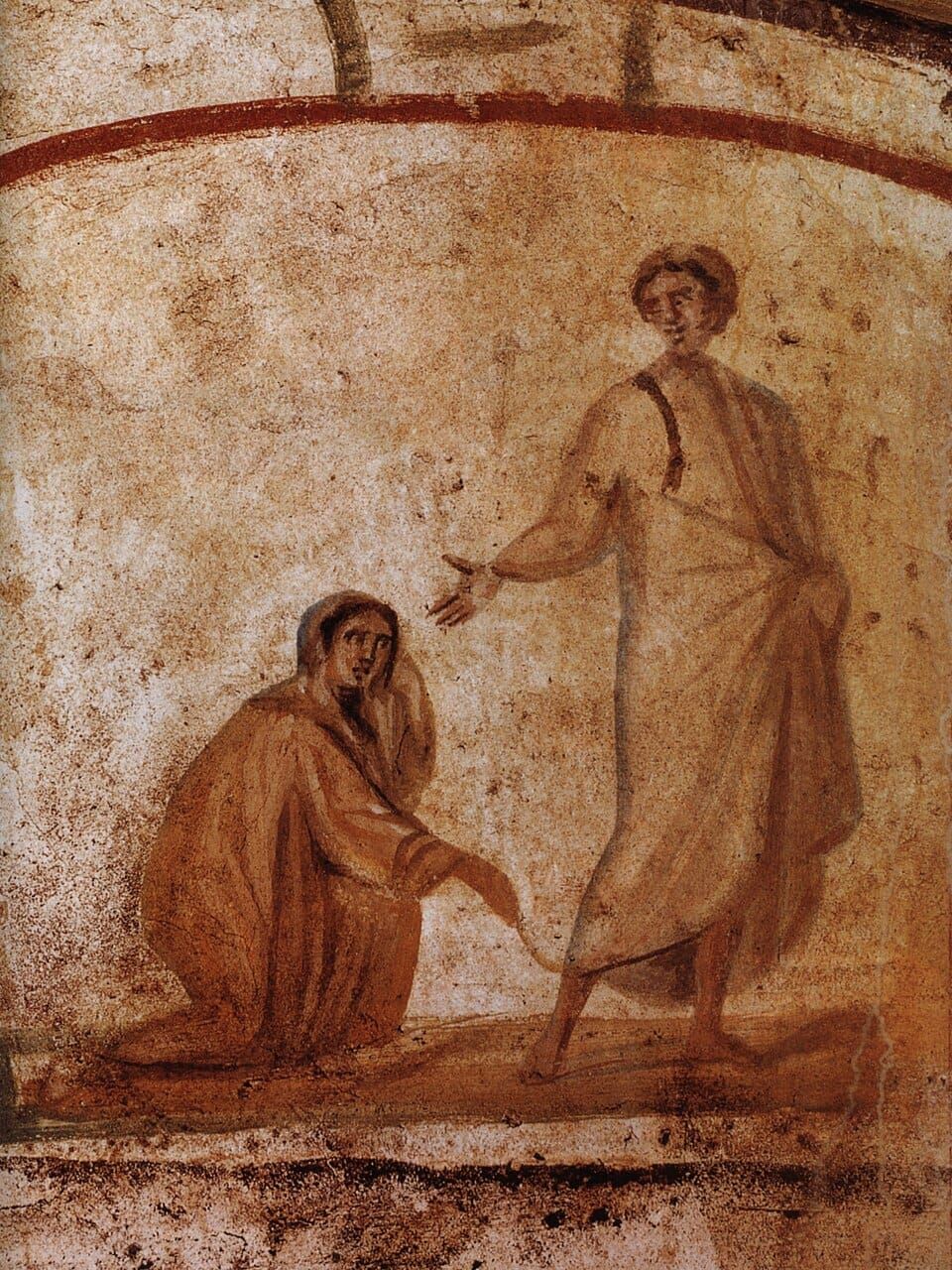
The Gospel shows what this espousal looks like when it takes flesh and walks among men. A woman who had suffered for twelve years, whom the law counted unclean and whom the crowd would have thrust away, comes up behind Jesus in silence, saying within herself, "If only I can touch his cloak, I shall be cured." Around Him a whole multitude surged; many bodies brushed against His own; yet from one touch only did power go forth. Saint Augustine, pondering this scene, says it in four words: "The crowd jostles, faith touches." Here is the concrete lesson this day would press upon the soul: proximity is not faith. It is possible to stand near holy things for a lifetime — near the Scriptures, near the sacraments, near the very altar — and to remain a bystander in the crowd, brushing against grace without ever laying hold of it. Faith is another thing altogether: it is deliberate, it is personal, it ventures something; it stretches out a trembling hand where mere custom keeps its hands at its sides.
And Christ, for His part, does not merely tolerate the touch of the miserable. The Catechism says of Him that, "moved by so much suffering Christ not only allows himself to be touched by the sick, but he makes their miseries his own." He turned about, sought her face, and gave her more than a cure: "Courage, daughter! Your faith has saved you." The soul that reaches out to Him discovers that it was itself being sought all along.
Then He goes on to the house of grief, where the flute players and the mourners have already pronounced their verdict, and He says, "The girl is not dead but sleeping." They ridiculed Him, as the world has always ridiculed hope. But He put the noise out of doors, took the child by the hand, and she arose. "Hope," the Catechism teaches, "is the theological virtue by which we desire the kingdom of heaven and eternal life as our happiness, placing our trust in Christ's promises and relying not on our own strength, but on the help of the grace of the Holy Spirit." Pope Leo XIV, meditating upon this very page of the Gospel, draws the same conclusion: "Let us go to Jesus: He can heal us, He can revive us. Jesus is our hope!"
The lesson, then, gathers to a single point. The soul must leave the anonymity of the crowd. It must consent to be led into the desert, where the Bridegroom speaks to the heart; it must reach out its hand each day — in prayer, in confession, in the Eucharist — and touch Him deliberately whom so many touch only by accident. "You have made us for yourself, O Lord, and our heart is restless until it rests in you," Augustine confessed; and the hand that raised the sleeping child is stretched out still, for the love that espouses the soul forever is stronger than every infidelity, and stronger than death itself.
Lord Jesus, teach me to come to You not as one of the crowd but as the woman who touched You; give me a faith that reaches out and does not merely stand near. Speak to my heart in the desert You have prepared for me, and when grief mocks every hope within me, take me by the hand and raise me. Through Christ our Lord. Amen.
Sources & References
- "I will allure her; I will lead her into the desert and speak to her heart" / "I will espouse you to me forever…" — Hosea 2:16, 17c-18, 21-22 (First Reading, USCCB)
- "The LORD is gracious and merciful, slow to anger and of great kindness" — Psalm 145:2-3, 4-5, 6-7, 8-9 (Responsorial Psalm, USCCB)
- "If only I can touch his cloak…", "Courage, daughter! Your faith has saved you", "The girl is not dead but sleeping" — Matthew 9:18-26 (Gospel, USCCB)
- "God loves his people more than a bridegroom his beloved; his love will be victorious over even the worst infidelities" — Catechism of the Catholic Church, 219
- "Moved by so much suffering Christ not only allows himself to be touched by the sick, but he makes their miseries his own" — Catechism of the Catholic Church, 1505
- "Hope is the theological virtue by which we desire the kingdom of heaven…" — Catechism of the Catholic Church, 1817
- "The crowd jostles, faith touches" — St. Augustine, Sermon 243, 2, 2 (as quoted by Pope Leo XIV)
- "You have made us for yourself, O Lord, and our heart is restless until it rests in you" — St. Augustine, Confessions I, 1, 1
- "Let us go to Jesus: He can heal us, He can revive us. Jesus is our hope!" — Pope Leo XIV, General Audience, 25 June 2025 (Vatican News, Word of the Day, 6 July 2026)
La multitud oprime, pero la fe toca
📖 Sagrada Escritura Diaria
6 de julio de 2026 — Lunes de la XIV semana del Tiempo ordinario
Lecturas: Oseas 2, 16. 17-18. 21-22 • Salmo 144, 2-3. 4-5. 6-7. 8-9 • Mateo 9, 18-26
Hay en las palabras del profeta Oseas una quietud que el ruido del mundo no puede falsificar: "Yo conduciré a Israel, mi esposa infiel, al desierto y le hablaré al corazón." El Dios que hizo los cielos no somete al alma con estruendo; la aparta, lejos de la plaza y de sus muchas voces, hacia una soledad donde al fin pueda escucharlo. El desierto que promete no es lugar de abandono sino de desposorio, y la aridez que el alma tanto teme es a menudo el terreno mismo sobre el cual Él decide empeñar su palabra: "Yo te desposaré conmigo para siempre. Nos uniremos en la justicia y la rectitud, en el amor constante y la ternura."
Semejante lenguaje sorprende, y así debe ser. El Catecismo, contemplando este misterio, enseña que "Dios ama a su pueblo más que un esposo a su amada; este amor vencerá incluso las peores infidelidades." Israel había corrido tras sus ídolos, atribuyendo a Baal lo que debía al Señor, y la respuesta de Dios no fue rechazarla, sino enamorarla de nuevo. Lo que es verdad de la nación es verdad de cada alma. Toda alma que se ha extraviado — ¿y cuál no se ha extraviado? — está siendo atraída ahora mismo hacia ese lugar silencioso donde habla la misericordia; porque, como canta el salmista, "el Señor es compasivo y misericordioso, lento para enojarse y generoso para perdonar."
El Evangelio muestra cómo es este desposorio cuando toma carne y camina entre los hombres. Una mujer que había sufrido durante doce años, a quien la ley declaraba impura y a quien la multitud habría apartado, se acerca a Jesús por detrás, en silencio, diciendo dentro de sí: "Con sólo tocar su manto, me curaré." En torno a Él se agolpaba toda una muchedumbre; muchos cuerpos rozaban el suyo; y sin embargo, de un solo toque salió poder. San Agustín, meditando esta escena, lo dice en pocas palabras: "La multitud oprime, la fe toca." He aquí la lección concreta que este día quiere grabar en el alma: la cercanía no es fe. Es posible permanecer junto a las cosas santas toda una vida — junto a las Escrituras, junto a los sacramentos, junto al altar mismo — y seguir siendo un espectador entre la multitud, rozando la gracia sin asirla jamás. La fe es otra cosa: es deliberada, es personal, arriesga algo; extiende una mano temblorosa allí donde la mera costumbre mantiene las manos quietas.
Y Cristo, por su parte, no se limita a tolerar el contacto de los miserables. El Catecismo dice de Él que, "conmovido por tantos sufrimientos, Cristo no sólo se deja tocar por los enfermos, sino que hace suyas sus miserias." Él se volvió, buscó su rostro y le dio más que una curación: "Hija, ten confianza; tu fe te ha curado." El alma que se atreve a tocarlo descubre que era ella la buscada desde el principio.
Después Él sigue hasta la casa del duelo, donde los flautistas y las plañideras ya han pronunciado su veredicto, y dice: "La niña no está muerta; está dormida." Se burlaron de Él, como el mundo se ha burlado siempre de la esperanza. Pero hizo salir el ruido, tomó a la niña de la mano, y ésta se levantó. "La esperanza", enseña el Catecismo, "es la virtud teologal por la que aspiramos al Reino de los cielos y a la vida eterna como felicidad nuestra, poniendo nuestra confianza en las promesas de Cristo y apoyándonos no en nuestras fuerzas, sino en los auxilios de la gracia del Espíritu Santo." El Papa León XIV, meditando esta misma página del Evangelio, saca la misma conclusión: "Vayamos a Jesús: Él puede sanarnos, Él puede resucitarnos. ¡Jesús es nuestra esperanza!"
La lección, pues, se recoge en un solo punto. El alma debe abandonar el anonimato de la multitud. Debe consentir en ser conducida al desierto, donde el Esposo habla al corazón; debe extender su mano cada día — en la oración, en la confesión, en la Eucaristía — y tocarlo deliberadamente a Aquel a quien tantos tocan sólo por accidente. "Nos hiciste, Señor, para ti, y nuestro corazón está inquieto hasta que descanse en ti", confesaba Agustín; y la mano que levantó a la niña dormida sigue extendida todavía, porque el amor que desposa al alma para siempre es más fuerte que toda infidelidad, y más fuerte que la muerte misma.
Señor Jesús, enséñame a acercarme a Ti no como uno más de la multitud, sino como la mujer que te tocó; dame una fe que se atreva a extender la mano y no se contente con estar cerca. Háblale a mi corazón en el desierto que has preparado para mí, y cuando el dolor se burle de toda esperanza dentro de mí, tómame de la mano y levántame. Por Jesucristo nuestro Señor. Amén.
Fuentes y referencias
- "Yo conduciré a Israel, mi esposa infiel, al desierto y le hablaré al corazón" / "Yo te desposaré conmigo para siempre…" — Oseas 2, 16. 17-18. 21-22 (Primera lectura, USCCB en español)
- "El Señor es compasivo y misericordioso, lento para enojarse y generoso para perdonar" — Salmo 144, 2-3. 4-5. 6-7. 8-9 (Salmo responsorial, USCCB en español; numeración del Leccionario mexicano)
- "Con sólo tocar su manto, me curaré", "Hija, ten confianza; tu fe te ha curado", "La niña no está muerta; está dormida" — Mateo 9, 18-26 (Evangelio, USCCB en español)
- "Dios ama a su pueblo más que un esposo a su amada; este amor vencerá incluso las peores infidelidades" — Catecismo de la Iglesia Católica, 219
- "Conmovido por tantos sufrimientos, Cristo no sólo se deja tocar por los enfermos, sino que hace suyas sus miserias" — Catecismo de la Iglesia Católica, 1505
- "La esperanza es la virtud teologal por la que aspiramos al Reino de los cielos…" — Catecismo de la Iglesia Católica, 1817
- "La multitud oprime, la fe toca" — San Agustín, Sermón 243, 2, 2 (citado por el Papa León XIV)
- "Nos hiciste, Señor, para ti, y nuestro corazón está inquieto hasta que descanse en ti" — San Agustín, Confesiones I, 1, 1
- "Vayamos a Jesús: Él puede sanarnos, Él puede resucitarnos. ¡Jesús es nuestra esperanza!" — Papa León XIV, Audiencia general, 25 de junio de 2025 (Vatican News, Palabra del día, 6 de julio de 2026)