
📖 Daily Scripture
Wednesday, October 14, 2026 — Wednesday of the Twenty-eighth Week in Ordinary Time
Readings: Galatians 5:18-25 • Psalm 1:1-2, 3, 4, 6 • Luke 11:42-46
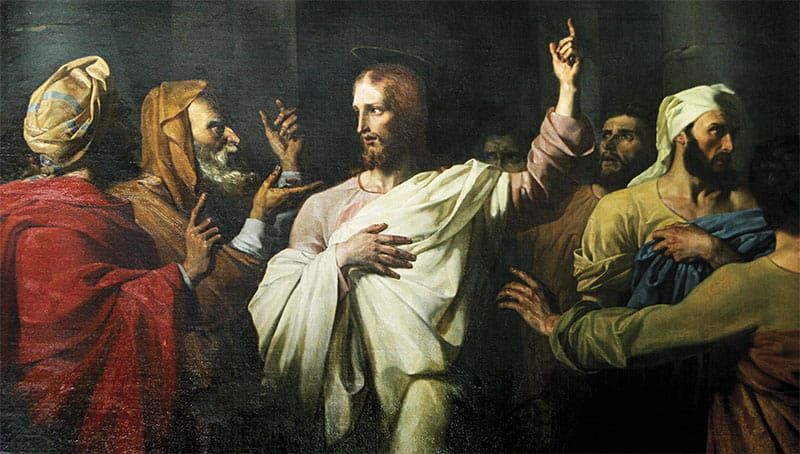
There is a peculiar danger which besets the religious soul, and it is the more subtle for wearing the garments of devotion. In the Gospel the Lord does not rebuke the Pharisees for carelessness but for a kind of exactness: they tithe mint and rue and every garden herb, measuring out to God the smallest leaves of their gardens, and yet, He says, “you pay no attention to judgment and to love for God.” It is possible, then, for a man to be scrupulous in what can be counted and negligent in what cannot; to keep a careful ledger of his observances while the great matters of the heart lie unattended, as a house may be swept in every corner while its master is away.
The reason is not hard to discover. What can be weighed can be finished; a tithe of mint is paid, and the conscience rests content. But justice and the love of God admit of no such completion. They are not sums to be settled but a life to be lived, and they ask not for a portion of the garden but for the whole soul. Hence the old temptation to prefer the measurable duty to the immeasurable one, and, having made religion a matter of rules, to lay those rules upon others as well, imposing “burdens hard to carry” which their authors “do not lift one finger to touch.” Severity toward others is very often the shadow cast by a heart that has not yet surrendered itself.
Against this St. Paul sets an altogether different image. He speaks not of works, which are counted, but of fruit, which grows: “the fruit of the Spirit is love, joy, peace, patience, kindness, generosity, faithfulness, gentleness, self-control.” Fruit is not manufactured; it ripens from within, from a living root drawing upon a hidden spring. So the Psalmist describes the just man as one who “is like a tree planted near running water,” whose leaves do not fade because its roots are fed. The Church teaches that “the fruits of the Spirit are perfections that the Holy Spirit forms in us as the first fruits of eternal glory.” They are formed in us; we do not fashion them for ourselves.
Here lies the lesson, plain and searching. The soul is not made holy by multiplying its exactness in little things while withholding itself in great ones, nor does it become just by measuring its neighbour more strictly than itself. The New Law, the Catechism reminds us, “is called a law of love because it makes us act out of the love infused by the Holy Spirit,” rather than from fear. The question to put to one’s own conscience is therefore not whether every small observance has been kept, but whether there is fruit: more patience than a year ago, more kindness toward those who try us, more gentleness where once there was severity. The small duties are not to be despised, for the Lord Himself says these should be done “without overlooking the others”; but they are the leaves, and God looks for the fruit.
St. Augustine, who knew the weariness of striving in his own strength, learned to pray, “Give what You command, and command what You will.” Elsewhere he gave the counsel which gathers the whole matter into a single line: “Love, and do what you will.” This is no license for laxity; it is the discovery that charity, once it reigns, orders all the rest. Pope Francis, reflecting on those who had reduced faith to a religion of prescriptions, observed that “the Spirit of God is not where there is rigidity, because the Spirit of God is liberty.” And the Catechism adds that the moral life animated by charity “gives to the Christian the spiritual freedom of the children of God.”
Let the soul, then, take heart. “Those who belong to Christ Jesus have crucified their flesh with its passions and desires,” and what remains after that crucifixion is not a barren discipline but a garden made ready for the Spirit. The Apostle’s counsel is simple: “If we live in the Spirit, let us also follow the Spirit.” God does not ask for an exact account of mint and rue; He asks for a heart laid open to His love, and He Himself, who planted the tree beside the waters, will bring the harvest in its season.
Lord Jesus, deliver me from that narrow exactness which measures the small and forgets the great. Plant me beside the running waters of Your Spirit, and form within me the fruit of love, patience, and gentleness, that I may help to lift the burdens of others rather than lay them down. Through Christ our Lord. Amen.
Sources & References
- “you pay no attention to judgment and to love for God” and “without overlooking the others” — Luke 11:42 (NABRE, Lectionary for Mass)
- “burdens hard to carry … do not lift one finger to touch” — Luke 11:46
- “the fruit of the Spirit is love, joy, peace, patience, kindness, generosity, faithfulness, gentleness, self-control” — Galatians 5:22-23
- “Those who belong to Christ Jesus have crucified their flesh with its passions and desires” — Galatians 5:24
- “If we live in the Spirit, let us also follow the Spirit” — Galatians 5:25
- “is like a tree planted near running water” — Psalm 1:3
- “the fruits of the Spirit are perfections that the Holy Spirit forms in us as the first fruits of eternal glory” — Catechism of the Catholic Church, 1832
- “is called a law of love because it makes us act out of the love infused by the Holy Spirit” — Catechism of the Catholic Church, 1972
- “gives to the Christian the spiritual freedom of the children of God” — Catechism of the Catholic Church, 1828
- “Give what You command, and command what You will” — St. Augustine, Confessions, Book X, 29.40
- “Love, and do what you will” — St. Augustine, Homilies on the First Epistle of John, 7.8
- “the Spirit of God is not where there is rigidity, because the Spirit of God is liberty” — Pope Francis, Homily at Casa Santa Marta, 15 May 2020, featured in Vatican News “Word of the Day,” 14 October 2026
- Readings: USCCB, Wednesday of the Twenty-eighth Week in Ordinary Time (Lectionary 469)
El fruto que no se puede pesar
📖 Sagrada Escritura Diaria
Miércoles, 14 de octubre de 2026 — Miércoles de la XXVIII semana del Tiempo ordinario
Lecturas: Gálatas 5, 18-25 • Salmo 1, 1-2. 3. 4 y 6 • Lucas 11, 42-46
Hay un peligro singular que acecha al alma religiosa, tanto más sutil cuanto que se reviste con los ropajes de la devoción. En el Evangelio, el Señor no reprende a los fariseos por su descuido, sino por una cierta exactitud: pagan el diezmo de la menta, de la ruda y de toda clase de legumbres, midiendo para Dios las hojas más pequeñas de sus huertos, y, sin embargo, les dice, “se olvidan de la justicia y del amor de Dios”. Es posible, pues, que un hombre sea escrupuloso en lo que puede contarse y negligente en lo que no; que lleve un registro cuidadoso de sus observancias mientras los grandes asuntos del corazón quedan desatendidos, como una casa puede barrerse en cada rincón mientras su dueño está ausente.
La razón no es difícil de descubrir. Lo que puede pesarse puede terminarse; se paga el diezmo de la menta, y la conciencia descansa satisfecha. Pero la justicia y el amor de Dios no admiten semejante conclusión. No son cuentas que se saldan, sino una vida que se vive, y no piden una porción del huerto, sino el alma entera. De ahí la antigua tentación de preferir el deber medible al inmensurable y, habiendo hecho de la religión un asunto de reglas, imponer esas reglas también a los demás, abrumando a la gente “con cargas insoportables” que sus autores no tocan “ni con la punta del dedo”. La severidad hacia los demás es muy a menudo la sombra que proyecta un corazón que todavía no se ha entregado.
Frente a esto, san Pablo propone una imagen del todo distinta. No habla de obras, que se cuentan, sino de frutos, que crecen: “los frutos del Espíritu Santo son: el amor, la alegría, la paz, la generosidad, la benignidad, la bondad, la fidelidad, la mansedumbre y el dominio de sí mismo”. El fruto no se fabrica; madura desde dentro, desde una raíz viva que bebe de un manantial escondido. Así describe el salmista al justo: “Es como un árbol plantado junto al río”, cuyas hojas no se marchitan porque sus raíces están alimentadas. La Iglesia enseña que “los frutos del Espíritu son perfecciones que forma en nosotros el Espíritu Santo como primicias de la gloria eterna”. Son formados en nosotros; no los fabricamos nosotros mismos.
Aquí está la lección, sencilla y penetrante. El alma no se hace santa multiplicando su exactitud en las cosas pequeñas mientras se reserva en las grandes, ni se vuelve justa midiendo a su prójimo con más rigor que a sí misma. La Ley nueva, nos recuerda el Catecismo, “es llamada ley de amor, porque hace obrar por el amor que infunde el Espíritu Santo más que por el temor”. La pregunta que cada uno debe hacer a su propia conciencia no es, por tanto, si ha cumplido cada pequeña observancia, sino si hay fruto: más paciencia que hace un año, más bondad hacia quienes nos ponen a prueba, más mansedumbre allí donde antes había severidad. Los pequeños deberes no han de despreciarse, pues el mismo Señor dice: “Esto debían practicar sin descuidar aquello”; pero son las hojas, y Dios busca el fruto.
San Agustín, que conoció el cansancio de luchar con sus propias fuerzas, aprendió a orar: “Da lo que mandas y manda lo que quieras”. En otro lugar dio el consejo que recoge toda la cuestión en una sola línea: “Ama y haz lo que quieras”. No es una licencia para la relajación; es el descubrimiento de que la caridad, una vez que reina, ordena todo lo demás. El papa Francisco, reflexionando sobre quienes habían reducido la fe a una religión de prescripciones, observó: “Donde hay rigidez no está el Espíritu de Dios, porque el Espíritu de Dios es libertad”. Y el Catecismo añade que la práctica de la vida moral animada por la caridad “da al cristiano la libertad espiritual de los hijos de Dios”.
Que el alma, pues, cobre ánimo. “Los que son de Jesucristo ya han crucificado su egoísmo junto con sus pasiones y malos deseos”, y lo que queda después de esa crucifixión no es una disciplina estéril, sino un huerto preparado para el Espíritu. El consejo del Apóstol es sencillo: “Si tenemos la vida del Espíritu, actuemos conforme a ese mismo Espíritu”. Dios no pide una cuenta exacta de la menta y de la ruda; pide un corazón abierto a su amor, y Él mismo, que plantó el árbol junto a las aguas, traerá la cosecha a su tiempo.
Señor Jesús, líbrame de esa estrecha exactitud que mide lo pequeño y olvida lo grande. Plántame junto a las aguas vivas de tu Espíritu y forma dentro de mí el fruto del amor, de la paciencia y de la mansedumbre, para que ayude a levantar las cargas de los demás en lugar de imponerlas. Por Jesucristo nuestro Señor. Amén.
Fuentes y referencias
- “se olvidan de la justicia y del amor de Dios” y “Esto debían practicar sin descuidar aquello” — Lucas 11, 42 (Leccionario, USCCB)
- “con cargas insoportables … ni con la punta del dedo” — Lucas 11, 46
- “los frutos del Espíritu Santo son: el amor, la alegría, la paz, la generosidad, la benignidad, la bondad, la fidelidad, la mansedumbre y el dominio de sí mismo” — Gálatas 5, 22-23
- “Los que son de Jesucristo ya han crucificado su egoísmo junto con sus pasiones y malos deseos” — Gálatas 5, 24
- “Si tenemos la vida del Espíritu, actuemos conforme a ese mismo Espíritu” — Gálatas 5, 25
- “Es como un árbol plantado junto al río” — Salmo 1, 3
- “los frutos del Espíritu son perfecciones que forma en nosotros el Espíritu Santo como primicias de la gloria eterna” — Catecismo de la Iglesia Católica, 1832
- “es llamada ley de amor, porque hace obrar por el amor que infunde el Espíritu Santo más que por el temor” — Catecismo de la Iglesia Católica, 1972
- “da al cristiano la libertad espiritual de los hijos de Dios” — Catecismo de la Iglesia Católica, 1828
- “Da lo que mandas y manda lo que quieras” — san Agustín, Confesiones, libro X, 29, 40
- “Ama y haz lo que quieras” — san Agustín, Homilías sobre la Primera Carta de san Juan, 7, 8
- “Donde hay rigidez no está el Espíritu de Dios, porque el Espíritu de Dios es libertad” — papa Francisco, homilía en la Casa Santa Marta, 15 de mayo de 2020 («La relación con Dios es gratuita, es una relación de amistad», vatican.va); comentario destacado por Vatican News el 14 de octubre de 2026
- Lecturas: USCCB, Miércoles de la XXVIII semana del Tiempo ordinario (Leccionario 469)