
📖 Daily Scripture
Sunday, October 18, 2026 — Twenty-ninth Sunday in Ordinary Time
Readings: Isaiah 45:1, 4-6 • Psalm 96:1, 3, 4-5, 7-8, 9-10 • 1 Thessalonians 1:1-5b • Matthew 22:15-21
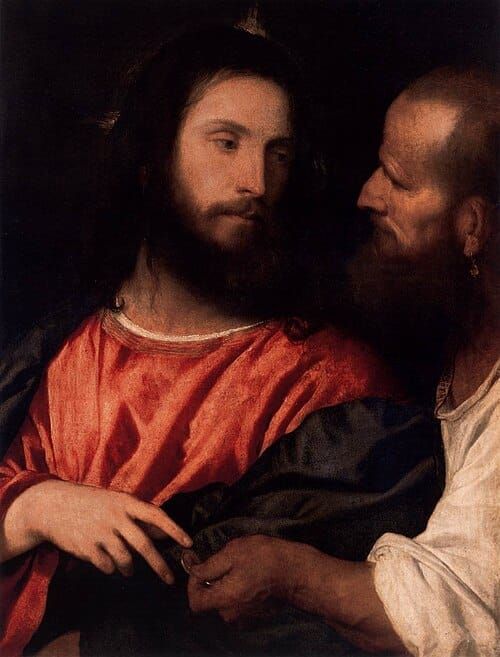
There is a moment in the Gospel of this day when a small and ordinary thing is lifted into the light and made to bear the weight of eternity. A coin is brought forward, such as passed through countless hands in the markets of Judea, worn by commerce and warm with the anxieties of men; and the Lord, approached with flattery and with a snare, does not answer the question put to Him, but asks one of His own: “Whose image is this and whose inscription?” The answer is plain, “Caesar’s,” and from that plain answer He draws a sentence which the soul can never wholly exhaust: “Then repay to Caesar what belongs to Caesar and to God what belongs to God.”
It is easy to hear these words as a mere settlement of accounts between two powers, as though the Lord had drawn a tidy line across the map of human life and assigned one province to the emperor and another to heaven. Yet the saying cuts far deeper than any question of tribute. The coin bears Caesar’s likeness, and so it returns to Caesar; what, then, bears the likeness of God? Tertullian answered without hesitation: “the image of Caesar, which is on the coin, to Caesar, and the image of God, which is on man, to God.” The soul itself is the coin of the Kingdom. Pope Benedict XVI, pondering this very passage, observed that every person “carries in him- or herself another image, that of God,” and that “it is to him and to him alone that each one owes his or her existence.” The Church teaches the same truth with quiet firmness: “Being in the image of God the human individual possesses the dignity of a person, who is not just something, but someone.”
Here the lesson of the day presses upon the conscience. If the soul is God’s coin, it may yet be spent in the wrong market. Few in our age are tempted to bow before carved figures; but the Catechism reminds us that “Idolatry not only refers to false pagan worship,” for “Man commits idolatry whenever he honors and reveres a creature in place of God,” whether this be “power, pleasure, race, ancestors, the state, money, etc.” Caesar has his rightful claims, and the conscientious soul pays them honestly and without complaint; but Caesar becomes an idol the moment he is given what he cannot rightly receive: the final allegiance of the heart, the hours that belong to prayer, the conscience that belongs to truth. The quiet tragedy of many lives is not open rebellion against God, but a gradual surrender of His image to lesser masters, until the likeness is scarcely legible.
St. Augustine knew this sorrow well. “The impression that was stamped upon us has been rubbed out by our wandering,” he confessed; and yet he added at once, “He has come to refashion, for He it was that fashioned us at first.” His counsel is brief and searching: “to Caesar his money, to God yourselves.” Let the soul, then, examine its own inscription. What in my days bears the stamp of anxiety, of ambition, of mere habit? Does my money serve charity, or does money silently command me? Do I give to God the first fruits of my attention, or only its weary remnant?
The prophet Isaiah shows a God who called even the pagan Cyrus by name, “giving you a title, though you knew me not,” that all might learn, “I am the LORD and there is no other.” If He so guides those who do not know Him, how much more tenderly does He seek the soul that bears His likeness and knows His voice. The Psalmist’s summons, “Give the Lord glory and honor,” is answered not by one grand gesture but by what St. Paul praised in the Thessalonians: the “work of faith and labor of love and endurance in hope,” the steady, hidden rendering of oneself to God through the ordinary hours.
And here is the consolation that crowns the lesson. The image of God in the soul may be dimmed, but it is never wholly effaced; the Hand that first engraved it has come in Christ to restore it. To render oneself to God is not to lose oneself but to be given back, made legible again, bright with the countenance of Him who loves us beyond all telling, and who has never ceased to call us by our name.
Father of mercies, You have stamped Your image upon my soul and called me by my name. Teach me to give the world only what is the world’s, and to give myself wholly to You. Restore within me the likeness my wandering has worn away, that my whole life may give You glory and honor. Through Christ our Lord. Amen.
Sources & References
- “Whose image is this and whose inscription?” … “Caesar’s.” … “Then repay to Caesar what belongs to Caesar and to God what belongs to God.” — Matthew 22:20-21 (NABRE, USCCB Lectionary)
- “giving you a title, though you knew me not” and “I am the LORD and there is no other” — Isaiah 45:4-5
- “Give the Lord glory and honor.” — Psalm 96, Responsorial refrain
- “work of faith and labor of love and endurance in hope” — 1 Thessalonians 1:3
- “the image of Caesar, which is on the coin, to Caesar, and the image of God, which is on man, to God” — Tertullian, On Idolatry, ch. 15 (Ante-Nicene Fathers, vol. 3)
- “carries in him- or herself another image, that of God” and “it is to him and to him alone that each one owes his or her existence” — Pope Benedict XVI, Homily for the Holy Mass for the New Evangelization, October 16, 2011 (cited by Vatican News, Word of the Day, October 18, 2026)
- “Being in the image of God the human individual possesses the dignity of a person, who is not just something, but someone.” — Catechism of the Catholic Church, 357
- “Idolatry not only refers to false pagan worship” … “Man commits idolatry whenever he honors and reveres a creature in place of God” … “power, pleasure, race, ancestors, the state, money, etc.” — Catechism of the Catholic Church, 2113
- “The impression that was stamped upon us has been rubbed out by our wandering” … “He has come to refashion, for He it was that fashioned us at first” … “to Caesar his money, to God yourselves” — St. Augustine, Tractates on the Gospel of John, Tractate 40, 9 (Nicene and Post-Nicene Fathers, Series 1, vol. 7)
La imagen grabada en el alma
📖 Sagrada Escritura Diaria
Domingo 18 de octubre de 2026 — XXIX Domingo ordinario
Lecturas: Isaías 45, 1. 4-6 • Salmo 95, 1 y 3. 4-5. 7-8. 9-10a y c • 1 Tesalonicenses 1, 1-5 • Mateo 22, 15-21
Hay un momento en el Evangelio de este día en que una cosa pequeña y ordinaria es alzada a la luz y hecha portadora del peso de la eternidad. Se presenta una moneda, como las que pasaban por innumerables manos en los mercados de Judea, gastada por el comercio y tibia aún de las inquietudes de los hombres; y el Señor, abordado con adulación y con una trampa, no responde a la pregunta que se le hace, sino que formula una propia: «¿De quién es esta imagen y esta inscripción?». La respuesta es sencilla, «Del César», y de esa respuesta sencilla Él saca una sentencia que el alma nunca podrá agotar del todo: «Den, pues, al César lo que es del César, y a Dios lo que es de Dios».
Es fácil escuchar estas palabras como un mero reparto de cuentas entre dos poderes, como si el Señor hubiera trazado una línea ordenada sobre el mapa de la vida humana, asignando una provincia al emperador y otra al cielo. Pero la sentencia penetra mucho más hondo que cualquier cuestión de tributo. La moneda lleva la efigie del César, y por eso vuelve al César; ¿qué es, entonces, lo que lleva la semejanza de Dios? Tertuliano respondió sin vacilar: «la imagen del César, que está en la moneda, al César; y la imagen de Dios, que está en el hombre, a Dios». El alma misma es la moneda del Reino. El Papa Benedicto XVI, meditando este mismo pasaje, observó que el hombre, todo hombre, «lleva en sí mismo otra imagen, la de Dios» «y, por tanto, a él, y sólo a él, cada uno debe su existencia». La Iglesia enseña la misma verdad con serena firmeza: «Por haber sido hecho a imagen de Dios, el ser humano tiene la dignidad de persona; no es solamente algo, sino alguien».
Aquí la lección del día apremia a la conciencia. Si el alma es moneda de Dios, puede aún ser gastada en el mercado equivocado. Pocos en nuestro tiempo se sienten tentados a postrarse ante figuras talladas; pero el Catecismo recuerda que «la idolatría no se refiere sólo a los cultos falsos del paganismo», pues «hay idolatría desde el momento en que el hombre honra y reverencia a una criatura en lugar de Dios», trátese «de poder, de placer, de la raza, de los antepasados, del Estado, del dinero, etc.». El César tiene sus justos derechos, y el alma recta los paga con honradez y sin queja; pero el César se convierte en ídolo en el momento en que se le entrega lo que no puede recibir con justicia: la lealtad última del corazón, las horas que pertenecen a la oración, la conciencia que pertenece a la verdad. La callada tragedia de muchas vidas no es la rebelión abierta contra Dios, sino la entrega gradual de su imagen a señores menores, hasta que la semejanza apenas se puede leer.
San Agustín conoció bien esta tristeza. «La impronta que fue grabada en nosotros se ha borrado por nuestro extravío», confesó; y añadió enseguida: «Él ha venido a rehacernos, porque fue Él quien al principio nos hizo». Su consejo es breve y penetrante: «al César, su moneda; a Dios, vosotros mismos». Examine, pues, el alma su propia inscripción. ¿Qué hay en mis días que lleve el sello de la ansiedad, de la ambición, de la mera costumbre? ¿Sirve mi dinero a la caridad, o es el dinero el que en silencio me gobierna? ¿Doy a Dios las primicias de mi atención, o solo su cansado residuo?
El profeta Isaías muestra a un Dios que llamó por su nombre incluso al pagano Ciro —«te llamé por tu nombre y te di un título de honor»—, para que todos aprendieran: «Yo soy el Señor y no hay otro». Si así guía a quienes no lo conocen, ¡con cuánta mayor ternura busca al alma que lleva su semejanza y conoce su voz! La invitación del salmista, «Cantemos la grandeza del Señor», no se responde con un solo gesto grandioso, sino con aquello que san Pablo alabó en los tesalonicenses: la fe, «los trabajos fatigosos que ha emprendido su amor» y «la perseverancia que les da su esperanza en Jesucristo»; la entrega constante y escondida de uno mismo a Dios a lo largo de las horas ordinarias.
Y he aquí el consuelo que corona la lección. La imagen de Dios en el alma puede oscurecerse, pero nunca se borra por completo; la Mano que primero la grabó ha venido en Cristo a restaurarla. Entregarse a Dios no es perderse, sino ser devuelto a sí mismo, hecho de nuevo legible, resplandeciente con el rostro de Aquel que nos ama más allá de toda palabra y que nunca ha dejado de llamarnos por nuestro nombre.
Padre de misericordia, Tú has grabado tu imagen en mi alma y me has llamado por mi nombre. Enséñame a dar al mundo solo lo que es del mundo, y a entregarme por entero a Ti. Restaura en mí la semejanza que mi extravío ha desgastado, para que toda mi vida cante tu grandeza. Por Jesucristo nuestro Señor. Amén.
Fuentes y referencias
- «¿De quién es esta imagen y esta inscripción?» … «Del César» … «Den, pues, al César lo que es del César, y a Dios lo que es de Dios» — Mateo 22, 20-21 (Leccionario, USCCB en español)
- «te llamé por tu nombre y te di un título de honor» y «Yo soy el Señor y no hay otro» — Isaías 45, 4-5
- «Cantemos la grandeza del Señor» — Salmo 95 (96), respuesta del salmo responsorial
- «los trabajos fatigosos que ha emprendido su amor» y «la perseverancia que les da su esperanza en Jesucristo» — 1 Tesalonicenses 1, 3
- «la imagen del César, que está en la moneda, al César; y la imagen de Dios, que está en el hombre, a Dios» — Tertuliano, Sobre la idolatría, cap. 15 (traducción al español a partir de la versión inglesa de los Ante-Nicene Fathers, vol. 3)
- «lleva en sí mismo otra imagen, la de Dios» y «y, por tanto, a él, y sólo a él, cada uno debe su existencia» — Papa Benedicto XVI, Homilía en la Santa Misa para la Nueva Evangelización, 16 de octubre de 2011 (citada por Vatican News, Palabra del día, 18 de octubre de 2026)
- «Por haber sido hecho a imagen de Dios, el ser humano tiene la dignidad de persona; no es solamente algo, sino alguien» — Catecismo de la Iglesia Católica, 357
- «la idolatría no se refiere sólo a los cultos falsos del paganismo» … «hay idolatría desde el momento en que el hombre honra y reverencia a una criatura en lugar de Dios» … «de poder, de placer, de la raza, de los antepasados, del Estado, del dinero, etc.» — Catecismo de la Iglesia Católica, 2113
- «La impronta que fue grabada en nosotros se ha borrado por nuestro extravío» … «Él ha venido a rehacernos, porque fue Él quien al principio nos hizo» … «al César, su moneda; a Dios, vosotros mismos» — San Agustín, Tratados sobre el Evangelio de san Juan, Tratado 40, 9 (traducción al español a partir de la versión inglesa de los Nicene and Post-Nicene Fathers)