
📖 Daily Scripture
Friday, August 28, 2026 — Memorial of Saint Augustine, Bishop and Doctor of the Church
Readings: 1 Corinthians 1:17-25 • Psalm 33:1-2, 4-5, 10-11 • Matthew 25:1-13
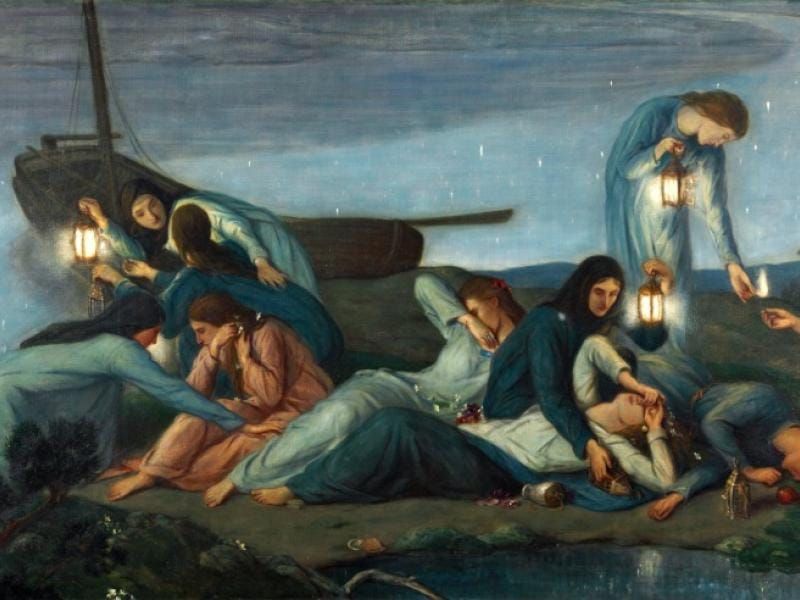
Two figures are set before the soul this morning, and they are one figure seen twice: a cross that the clever of the world dismiss as folly, and a lamp that has quietly run dry. Saint Paul writes to a city in love with its own eloquence, and he refuses to compete with it; he will not decorate the Gospel, lest the cross of Christ be emptied of its meaning. And in the Gospel, five young women arrive at the door of the wedding carrying everything except the one thing that mattered.
The wisdom the world admires is a wisdom of measurement. It calculates what a thing costs, what it returns, how it will appear. The wisdom of God does not calculate; it pours itself out and keeps nothing back, and so it looks, to the calculating eye, like waste. This is why the Church has never been embarrassed by the scandal at her centre. The Catechism says it plainly: Christ crucified is thus "the power of God and the wisdom of God. For the foolishness of God is wiser than men, and the weakness of God is stronger than men." What appears to be defeat is in truth the only strength that has ever conquered anything.
And the oil? The ancient interpreters of the parable — and the Popes after them — have read it as charity: love that cannot be purchased, that is received as a gift, kept within, and spent in works. This is the whole difficulty and the whole mercy of the parable. Oil cannot be borrowed at midnight. No one can lend another the habit of prayer he never formed, the patience he never practised, the mercy he never gave away. There are goods that can be handed across at the last moment, and there are goods that must be slowly accumulated in the dark, and the second kind is what the soul will be asked for.
Notice that all ten slept. The drowsiness was not the failure; the emptiness was. Every one of those lamps was lit at the beginning, and every one of them had been carried out into the evening with real intention. The difference between the wise and the foolish was decided long before the cry at midnight — decided in the ordinary, unwitnessed hours, in the alms given without a word, in the patience borne with a difficult relative, in the Mass attended when no consolation attended it. These unremarkable acts are the flask carried beside the lamp. They will not feel, at the time, like anything at all. That is precisely why they must be done, and done now.
This is the concrete labour to which today calls: not a grand resolution, but the deliberate storing up of small charity while there is still daylight in which to store it. The Catechism does not soften what such storing costs: "The way of perfection passes by way of the Cross. There is no holiness without renunciation and spiritual battle." The cross Paul preaches and the flask the wise virgins carried are the same thing, seen from two sides — a love that is willing to be spent.
Saint Augustine, whose memorial the Church keeps today, knew better than most what it is to come to a door late. "Late have I loved you, Beauty so ancient and so new: late have I loved you." Yet he was not shut out. He was given years in which to begin filling the flask he had left empty, and he filled it, and the Church has been warmed by that lamp for sixteen centuries. So the parable, for all its closed door, is not finally a threat but a summons offered while there is still time. "Since we know neither the day nor the hour, we should follow the advice of the Lord and watch constantly so that, when the single course of our earthly life is completed, we may merit to enter with him into the marriage feast and be numbered among the blessed."
And what waits behind that door is not a reckoning but a wedding. Saint Cyprian could scarcely find words for it: "How great will your glory and happiness be, to be allowed to see God, to be honored with sharing the joy of salvation and eternal light with Christ your Lord and God." The bridegroom is delayed, but he is coming; and every quiet act of love performed today is oil already in the flask.
Lord, teach me to love in the hours no one sees, and to store within me the charity I cannot borrow when the cry comes at midnight. Keep my lamp burning through the long delay, and let no wisdom of this world persuade me to be ashamed of your Cross. When the door opens, may you know me. Through Christ our Lord. Amen.
Sources & References
- "Christ did not send me to baptize but to preach the Gospel… we proclaim Christ crucified" — 1 Corinthians 1:17-25 (First Reading, USCCB)
- "The earth is full of the goodness of the Lord" — Psalm 33:1-2, 4-5, 10-11 (Responsorial Psalm, USCCB)
- "Therefore, stay awake, for you know neither the day nor the hour" — Matthew 25:1-13 (Gospel, USCCB)
- "Christ crucified is thus 'the power of God and the wisdom of God…'" — Catechism of the Catholic Church, 272
- "The way of perfection passes by way of the Cross. There is no holiness without renunciation and spiritual battle." — Catechism of the Catholic Church, 2015
- "Since we know neither the day nor the hour, we should follow the advice of the Lord and watch constantly…" — Catechism of the Catholic Church, 1036, citing Lumen Gentium 48
- "Late have I loved you, Beauty so ancient and so new: late have I loved you." — Saint Augustine, Confessions X, 27
- "How great will your glory and happiness be, to be allowed to see God…" — Saint Cyprian of Carthage, Letter 58, 10, quoted in Catechism of the Catholic Church, 1028
- The oil of the parable read as charity that cannot be purchased but is received as gift, kept within, and used in works — Pope Benedict XVI, Angelus, 6 November 2011 (citing Saint Augustine, Sermon 93, 4), Vatican News "Word of the Day," 28 August 2026
La lámpara que se alimenta en secreto
📖 Sagrada Escritura Diaria
Viernes 28 de agosto de 2026 — Memoria de San Agustín, obispo y doctor de la Iglesia
Lecturas: 1 Corintios 1, 17-25 • Salmo 32, 1-2. 4-5. 10ab y 11 • Mateo 25, 1-13
Dos figuras se presentan hoy al alma, y en realidad son una sola figura vista dos veces: una cruz que los sabios de este mundo desechan como locura, y una lámpara que se ha ido apagando en silencio. San Pablo escribe a una ciudad enamorada de su propia elocuencia, y se niega a competir con ella; no adornará el Evangelio, para no hacer ineficaz la cruz de Cristo. Y en el Evangelio, cinco jóvenes llegan a la puerta de la boda llevándolo todo, excepto lo único que importaba.
La sabiduría que el mundo admira es una sabiduría de medida. Calcula lo que algo cuesta, lo que rinde, cómo se verá. La sabiduría de Dios no calcula: se derrama entera y nada se reserva, y por eso, a los ojos que calculan, parece desperdicio. Por esto la Iglesia nunca se ha avergonzado del escándalo que está en su centro. El Catecismo lo dice sin rodeos: Cristo crucificado es "poder de Dios y sabiduría de Dios. Porque la necedad divina es más sabia que la sabiduría de los hombres, y la debilidad divina, más fuerte que la fuerza de los hombres". Lo que parece derrota es en verdad la única fuerza que ha vencido algo alguna vez.
¿Y el aceite? Los intérpretes antiguos de la parábola —y los Papas después de ellos— lo han leído como la caridad: un amor que no puede comprarse, que se recibe como don, se guarda dentro y se gasta en obras. Ahí está toda la dificultad y toda la misericordia de la parábola. El aceite no se presta a medianoche. Nadie puede prestar a otro el hábito de oración que nunca formó, la paciencia que nunca ejercitó, la misericordia que nunca entregó. Hay bienes que pueden pasarse de mano en el último instante, y hay bienes que deben acumularse lentamente en la oscuridad; y es el segundo género el que se pedirá al alma.
Conviene notar que las diez se durmieron. El sueño no fue el fracaso; lo fue el vacío. Todas aquellas lámparas se encendieron al principio, y todas fueron llevadas a la noche con verdadera intención. La diferencia entre las previsoras y las descuidadas quedó decidida mucho antes del grito de medianoche: decidida en las horas ordinarias que nadie vio, en la limosna dada sin una palabra, en la paciencia sostenida ante un familiar difícil, en la Misa a la que se asiste cuando ningún consuelo acompaña. Esos actos sin brillo son el frasco que va junto a la lámpara. En su momento no se sentirán como nada en absoluto. Precisamente por eso deben hacerse, y hacerse ahora.
Esta es la labor concreta a la que hoy llama: no un propósito grandioso, sino el almacenamiento deliberado de pequeña caridad mientras aún queda luz para almacenarla. El Catecismo no suaviza lo que ese almacenamiento cuesta: "El camino de la perfección pasa por la cruz. No hay santidad sin renuncia y sin combate espiritual". La cruz que Pablo predica y el frasco que llevaban las previsoras son la misma cosa vista por dos lados: un amor dispuesto a gastarse.
San Agustín, cuya memoria celebra hoy la Iglesia, supo mejor que muchos lo que es llegar tarde a una puerta. "¡Tarde te amé, Hermosura tan antigua y tan nueva, tarde te amé!" Y sin embargo no quedó fuera. Se le dieron años para empezar a llenar el frasco que había dejado vacío, y lo llenó, y la Iglesia se ha calentado con esa lámpara durante dieciséis siglos. Así, la parábola, con toda su puerta cerrada, no es al final una amenaza sino una convocatoria ofrecida mientras aún hay tiempo. "Como no sabemos ni el día ni la hora, es necesario, según el consejo del Señor, estar continuamente en vela. Para que así, terminada la única carrera que es nuestra vida en la tierra, mereceremos entrar con Él en la boda y ser contados entre los santos".
Y lo que espera detrás de esa puerta no es un ajuste de cuentas, sino una boda. San Cipriano apenas hallaba palabras para decirlo: "¡Cuál no será tu gloria y tu dicha!: Ser admitido a ver a Dios, tener el honor de participar en las alegrías de la salvación y de la luz eterna en compañía de Cristo, el Señor tu Dios". El esposo tarda, pero viene; y cada acto callado de amor realizado hoy es aceite ya guardado en el frasco.
Señor, enséñame a amar en las horas que nadie ve, y a guardar dentro de mí la caridad que no podré pedir prestada cuando suene el grito de medianoche. Mantén encendida mi lámpara a lo largo de la larga espera, y que ninguna sabiduría de este mundo me persuada a avergonzarme de tu Cruz. Cuando la puerta se abra, que me reconozcas. Por Jesucristo nuestro Señor. Amén.
Fuentes y referencias
- "No me envió Cristo a bautizar, sino a predicar el Evangelio… nosotros predicamos a Cristo crucificado" — 1 Corintios 1, 17-25 (Primera lectura, USCCB)
- "El amor del Señor llena la tierra" — Salmo 32, 1-2. 4-5. 10ab y 11 (Salmo responsorial, USCCB)
- "Estén pues, preparados, porque no saben ni el día ni la hora" — Mateo 25, 1-13 (Evangelio, USCCB)
- "Cristo crucificado es 'poder de Dios y sabiduría de Dios…'" — Catecismo de la Iglesia Católica, 272
- "El camino de la perfección pasa por la cruz. No hay santidad sin renuncia y sin combate espiritual." — Catecismo de la Iglesia Católica, 2015
- "Como no sabemos ni el día ni la hora, es necesario, según el consejo del Señor, estar continuamente en vela…" — Catecismo de la Iglesia Católica, 1036, citando Lumen Gentium 48
- "¡Tarde te amé, Hermosura tan antigua y tan nueva, tarde te amé!" — San Agustín, Confesiones X, 27
- "¡Cuál no será tu gloria y tu dicha!: Ser admitido a ver a Dios…" — San Cipriano de Cartago, Carta 58, 10, citado en el Catecismo de la Iglesia Católica, 1028
- El aceite de la parábola leído como la caridad que no se compra, sino que se recibe como don, se guarda dentro y se usa en obras — Papa Benedicto XVI, Ángelus, 6 de noviembre de 2011 (citando a San Agustín, Sermón 93, 4), Vatican News "Palabra del día", 28 de agosto de 2026