
📖 Daily Scripture
Sunday, November 8, 2026 — Thirty-second Sunday in Ordinary Time
Readings: Wisdom 6:12-16 • Psalm 63:2, 3-4, 5-6, 7-8 • 1 Thessalonians 4:13-18 • Matthew 25:1-13
The Book of Wisdom speaks of her as one who is never far from those who seek her. “Resplendent and unfading is wisdom,” it says, and “whoever watches for her at dawn shall not be disappointed.” There is something tender in that image of the watcher at dawn: the soul that rises before the light, not because the light is late, but because it longs to be awake when the light comes. The Psalmist gives that longing its proper voice: “My soul is thirsting for you, O Lord my God.”
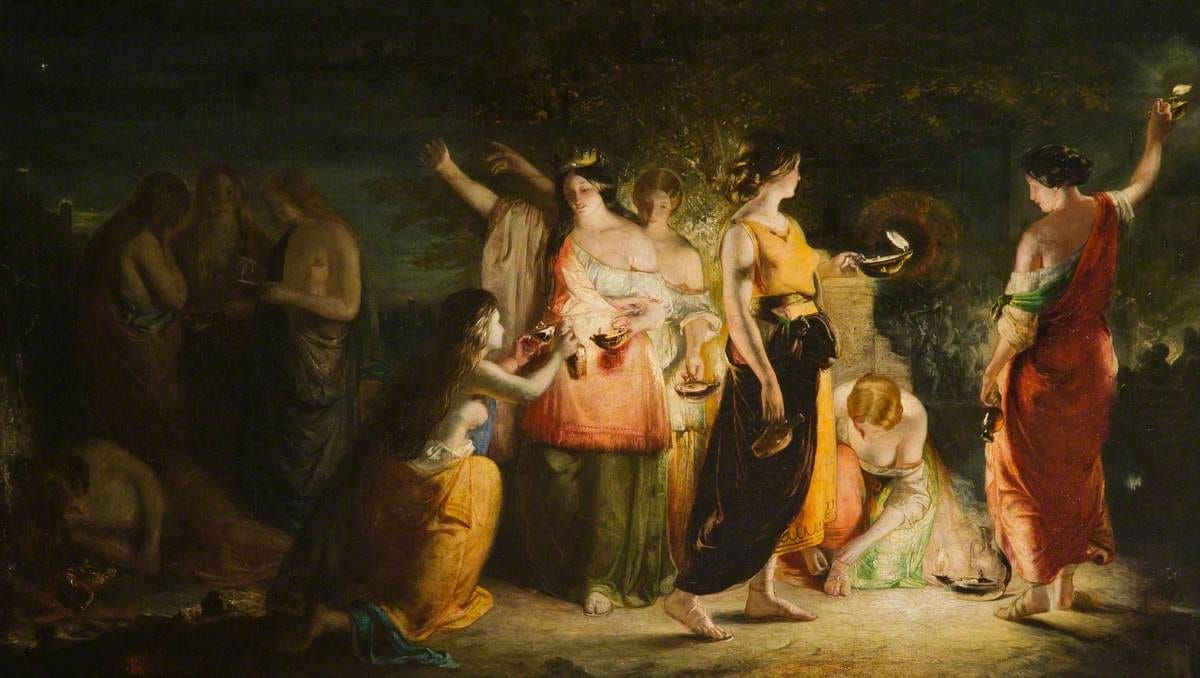
Our Lord, in the Gospel, takes up the same watchfulness and gives it a sober edge. Ten virgins go out to meet the bridegroom; all ten have lamps, all ten fall asleep as the night grows long. The difference between them is not that some stayed awake and others did not, but that some had provided oil and others had not. When the cry goes up at midnight, the foolish ask to borrow, and they cannot; they go to buy, and the door is shut. The answer that comes through it is among the most sorrowful words in the Gospels: “Amen, I say to you, I do not know you.”
The parable does not teach that the soul must never rest; even the wise virgins slept. It teaches something more searching: that there are preparations which cannot be made at the last moment, and which no one else can make for us. The oil cannot be borrowed because it is not a possession but a life. It is the slow accumulation of prayer, of charity, of fidelity in hidden things, the daily turning of the heart toward God when no one is watching and nothing seems to be at stake. Such oil is gathered drop by drop over years, and it is spent in a single hour of meeting.
Here lies the concrete lesson. The soul is tempted to treat its readiness for God as something it may arrange later, when life is quieter, when the present cares are settled. But the Church, echoing her Lord, counsels otherwise. The Catechism, drawing upon the Second Vatican Council, reminds us: “Since we know neither the day nor the hour, we should follow the advice of the Lord and watch constantly.” Watching constantly does not mean living in dread; it means living each ordinary day as one already belonging to the Bridegroom, so that His coming, whenever it is, finds a lamp already burning.
Nor is this watchfulness merely a duty. It is, at its root, desire. “Whether we realize it or not,” the Catechism teaches, “prayer is the encounter of God’s thirst with ours. God thirsts that we may thirst for him.” The oil of the wise virgins is nothing other than that answering thirst, kept alive. Saint Augustine, who came to such thirst only after long wandering, confessed it with famous sorrow and joy: “Late have I loved you, O Beauty ever ancient, ever new, late have I loved you!” Yet even late love is love, and the door that closes on the foolish is still open tonight to the soul that turns.
Saint Paul, writing to the Thessalonians who grieved their dead, assures them that the Lord will come and that “thus we shall always be with the Lord,” and he bids them console one another with these words. Pope Benedict XVI, reflecting upon this very Sunday, wrote that “those who believe in God-Love bear within them invincible hope.” The Catechism calls hope “the theological virtue by which we desire the kingdom of heaven and eternal life as our happiness.” This is the hope that fills the lamp.
So the soul need not fear the midnight cry. It need only keep its small flame fed, a prayer at morning, a mercy at noon, a surrender at night, until the Bridegroom comes, and the door opens, and the long watch gives way to the wedding feast that has no end.
Lord Jesus, Bridegroom of my soul, kindle within me a thirst for You that the long night cannot quench. Teach me to gather the oil of prayer and charity in hidden, ordinary hours, so that when You come, You may find my lamp burning and know me as Your own. Through Christ our Lord. Amen.
Sources & References
- “Resplendent and unfading is wisdom”; “whoever watches for her at dawn shall not be disappointed” — Wisdom 6:12, 14
- “My soul is thirsting for you, O Lord my God” — Psalm 63, responsorial refrain (Ps 63:2b)
- “Amen, I say to you, I do not know you” — Matthew 25:12
- “thus we shall always be with the Lord” — 1 Thessalonians 4:17; console one another — 4:18
- “Since we know neither the day nor the hour, we should follow the advice of the Lord and watch constantly” — CCC 1036, quoting Lumen Gentium 48
- “Whether we realize it or not, prayer is the encounter of God’s thirst with ours. God thirsts that we may thirst for him” — CCC 2560
- “the theological virtue by which we desire the kingdom of heaven and eternal life as our happiness” — CCC 1817
- “Late have I loved you, O Beauty ever ancient, ever new, late have I loved you!” — St. Augustine, Confessions X.27
- “those who believe in God-Love bear within them invincible hope” — Pope Benedict XVI, Angelus, 6 November 2011 (Vatican News, Word of the Day, 8 November 2026)
La lámpara que espera la aurora
📖 Sagrada Escritura Diaria
domingo, 8 de noviembre de 2026 — XXXII Domingo ordinario
Lecturas: Sabiduría 6, 12-16 • Salmo 62, 2. 3-4. 5-6. 7-8 • 1 Tesalonicenses 4, 13-18 • Mateo 25, 1-13
El Libro de la Sabiduría habla de ella como de alguien que nunca está lejos de quienes la buscan. “Radiante e incorruptible es la sabiduría”, dice, y añade que sale ella misma a buscar a los que son dignos de ella. Hay algo tierno en la imagen de quien madruga para esperarla: el alma que se levanta antes de la luz, no porque la luz se retrase, sino porque anhela estar despierta cuando la luz llegue. El salmista da a ese anhelo su voz propia: “Señor, mi alma tiene sed de ti.”
Nuestro Señor, en el Evangelio, recoge esa misma vigilancia y le da un filo sobrio. Diez vírgenes salen al encuentro del esposo; las diez llevan lámparas, las diez se duermen cuando la noche se alarga. La diferencia entre ellas no es que unas velaron y otras no, sino que unas se proveyeron de aceite y otras no. Cuando a medianoche se oye el grito, las necias piden prestado, y no pueden obtenerlo; van a comprar, y la puerta se cierra. La respuesta que llega a través de ella está entre las palabras más dolorosas del Evangelio: “Yo les aseguro que no las conozco.”
La parábola no enseña que el alma nunca deba descansar; también las prudentes durmieron. Enseña algo más penetrante: que hay preparativos que no pueden hacerse en el último momento, y que nadie puede hacer por nosotros. El aceite no puede prestarse porque no es una posesión, sino una vida. Es la lenta acumulación de la oración, de la caridad, de la fidelidad en las cosas escondidas, el volverse diario del corazón hacia Dios cuando nadie mira y nada parece estar en juego. Ese aceite se reúne gota a gota a lo largo de los años, y se gasta en una sola hora de encuentro.
Aquí está la lección concreta. El alma se siente tentada a tratar su preparación para Dios como algo que podrá arreglar más tarde, cuando la vida esté más tranquila, cuando se hayan resuelto los cuidados presentes. Pero la Iglesia, haciéndose eco de su Señor, aconseja otra cosa. El Catecismo, tomando las palabras del Concilio Vaticano II, nos recuerda: “Como no sabemos ni el día ni la hora, es necesario, según el consejo del Señor, estar continuamente en vela.” Velar continuamente no significa vivir con temor; significa vivir cada día ordinario como quien ya pertenece al Esposo, de modo que su venida, sea cuando sea, encuentre una lámpara ya encendida.
Y esta vigilancia no es un mero deber. En su raíz, es deseo. “La oración, sepámoslo o no, es el encuentro de la sed de Dios y de la sed del hombre”, enseña el Catecismo; “Dios tiene sed de que el hombre tenga sed de Él.” El aceite de las vírgenes prudentes no es otra cosa que esa sed que responde, mantenida viva. San Agustín, que llegó a esa sed sólo después de un largo extravío, la confesó con célebre dolor y alegría: “¡Tarde te amé, hermosura tan antigua y tan nueva, tarde te amé!” Pero aun el amor tardío es amor, y la puerta que se cierra para las necias sigue abierta esta noche para el alma que se vuelve.
San Pablo, escribiendo a los tesalonicenses que lloraban a sus muertos, les asegura que el Señor vendrá y que entonces estaremos siempre con Él, y les pide: “Consuélense, pues, unos a otros con estas palabras.” El Papa Benedicto XVI, meditando este mismo domingo, escribió: “Quien cree en Dios-Amor lleva en sí una esperanza invencible.” El Catecismo llama a la esperanza “la virtud teologal por la que aspiramos al Reino de los cielos y a la vida eterna como felicidad nuestra”. Ésa es la esperanza que llena la lámpara.
Así, el alma no necesita temer el grito de medianoche. Sólo necesita mantener alimentada su pequeña llama, una oración al amanecer, una misericordia al mediodía, una entrega por la noche, hasta que venga el Esposo, y se abra la puerta, y la larga vigilia ceda su lugar al banquete de bodas que no tiene fin.
Señor Jesús, Esposo de mi alma, enciende dentro de mí una sed de ti que la larga noche no pueda apagar. Enséñame a reunir el aceite de la oración y de la caridad en las horas escondidas y ordinarias, para que, cuando vengas, encuentres mi lámpara encendida y me reconozcas como tuyo. Por Jesucristo nuestro Señor. Amén.
Fuentes y referencias
- “Radiante e incorruptible es la sabiduría” — Sabiduría 6, 12; ella sale a buscar a los dignos de ella — Sabiduría 6, 16 (aludido)
- “Señor, mi alma tiene sed de ti” — Salmo 62, estribillo responsorial (Sal 62, 2b)
- “Yo les aseguro que no las conozco” — Mateo 25, 12
- “Consuélense, pues, unos a otros con estas palabras” — 1 Tesalonicenses 4, 18
- “Como no sabemos ni el día ni la hora, es necesario, según el consejo del Señor, estar continuamente en vela” — CIC 1036, citando Lumen Gentium 48
- “La oración, sepámoslo o no, es el encuentro de la sed de Dios y de la sed del hombre”; “Dios tiene sed de que el hombre tenga sed de Él” — CIC 2560
- “la virtud teologal por la que aspiramos al Reino de los cielos y a la vida eterna como felicidad nuestra” — CIC 1817
- “¡Tarde te amé, hermosura tan antigua y tan nueva, tarde te amé!” — San Agustín, Confesiones X, 27
- “Quien cree en Dios-Amor lleva en sí una esperanza invencible” — Papa Benedicto XVI, Ángelus, 6 de noviembre de 2011 (Vatican News, Evangelio del día, 8 de noviembre de 2026)