
📖 Daily Scripture
September 12, 2026 — Saturday of the Twenty-Third Week in Ordinary Time
Readings: 1 Corinthians 10:14-22 • Psalm 116:12-13, 17-18 • Luke 6:43-49
The Apostle's warning this morning rests upon a piece of realism we would rather not face: that to eat at a table is to be joined to what is offered there. He does not argue that the idol is anything, nor that the meat is anything; he argues that the act of communion is something, and that it does what it signifies. You cannot drink the cup of the Lord and also the cup of demons. The prohibition is not the jealousy of a rival, but the plain impossibility of belonging wholly to two masters, and the soul that attempts it does not become twice as rich. It becomes divided.
The Church states the matter with the same simplicity. "Human life finds its unity in the adoration of the one God," she teaches, and "the commandment to worship the Lord alone integrates man and saves him from an endless disintegration." This is worth pondering, for we are inclined to think of the first commandment as a restriction laid upon a life otherwise free, when in truth it is the only thing that holds a life together. The idols of our own age keep no temples and ask for no incense; they ask only that we arrange everything else around them. And what a man arranges his life around, he is slowly becoming.
Hence the Gospel's image of the tree. Every tree is known by its own fruit, and no amount of intention alters the kind of fruit a tree produces. A good person out of the store of goodness in his heart produces good, for from the fullness of the heart the mouth speaks. The Church points to the heart in precisely this biblical sense, as "the depths of one's being, where the person decides for or against God." The store is not filled by accident. It is filled by what we habitually approach — the table we choose, the company we keep, the thoughts we permit to lodge and remain.
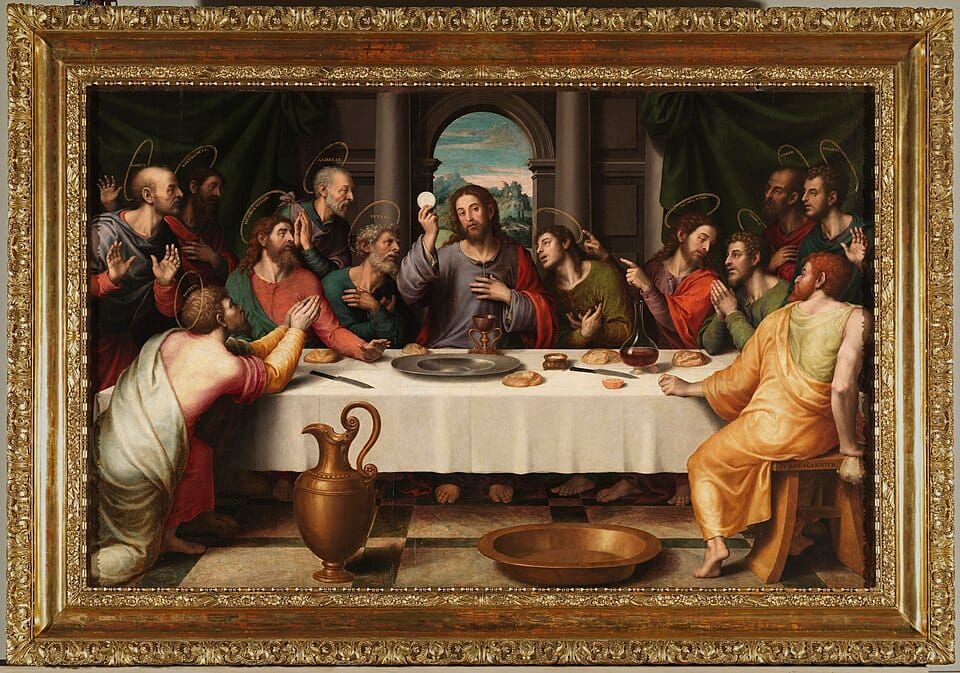
And it is here that the two readings become one. If the table shapes the heart, then the Table of the Lord is the school of the soul. The Eucharist makes the Church: because there is one bread, we who are many are one body, for we all partake of the one bread. Augustine draws the conclusion without softening it: "If you are the body and members of Christ, then it is your sacrament that is placed on the table of the Lord; it is your sacrament that you receive." Hearing the words, the Body of Christ, we answer Amen — and he warns us, "Be then a member of the Body of Christ that your Amen may be true."
Whether that Amen is true is settled outside the church door. The Eucharist commits us to the poor, and Chrysostom will not let the point go: "You have tasted the Blood of the Lord, yet you do not recognize your brother." He presses further still — God freed us from all our sins and invited us to this table, and we have not become more merciful. The fruit of a true communion is a widened heart. Where mercy has not grown, something has been received without being admitted.
This is why our Lord asks why we call him Lord, Lord, and do not do what he commands, and why the man who hears and acts is the one who dug deeply and laid his foundation on rock. A recent Successor of Peter observed that changing one's life is not a matter of putting on makeup; it means changing the foundations, and finding the Rock who is Christ. The digging is slow, unseen labour, and nothing of it shows above ground. But the flood comes to both houses alike, and only one of them stands.
Yet the day does not end in fear, but in gratitude. How shall I make a return to the Lord for all the good he has done for me? The cup of salvation I will take up, and I will call upon the name of the Lord. The cup we are given is the cup we lift in return; the Body we receive is the body we are asked to become. To have been invited at all is mercy, and the foundation we are told to dig down to has already been laid for us.
Lord, you have set before me a table I did not earn. Keep my heart undivided, that I may not take your cup with one hand and another's with the other. Fill the store within me with what is good, so that my words and my deeds may bear the fruit of the tree you planted. Teach me to dig deep, and to build where the flood cannot reach. Through Christ our Lord. Amen.
Sources & References
- "You cannot drink the cup of the Lord and also the cup of demons" — 1 Corinthians 10:21 (First Reading, Lectionary 442)
- "Because the loaf of bread is one, we, though many, are one Body" — 1 Corinthians 10:17
- "For every tree is known by its own fruit"; "from the fullness of the heart the mouth speaks" — Luke 6:44-45 (Gospel)
- "Why do you call me, 'Lord, Lord,' but not do what I command?"; "dug deeply and laid the foundation on rock" — Luke 6:46-48 (Gospel)
- "How shall I make a return to the LORD for all the good he has done for me? The cup of salvation I will take up" — Psalm 116:12-13 (Responsorial Psalm)
- "Human life finds its unity in the adoration of the one God. The commandment to worship the Lord alone integrates man and saves him from an endless disintegration." — Catechism of the Catholic Church, 2114
- "the depths of one's being, where the person decides for or against God" — Catechism of the Catholic Church, 368
- "The unity of the Mystical Body: the Eucharist makes the Church." — Catechism of the Catholic Church, 1396
- "If you are the body and members of Christ, then it is your sacrament that is placed on the table of the Lord; it is your sacrament that you receive"; "Be then a member of the Body of Christ that your Amen may be true" — St. Augustine, Sermo 272 (cited in CCC 1396)
- "The Eucharist commits us to the poor." — Catechism of the Catholic Church, 1397
- "You have tasted the Blood of the Lord, yet you do not recognize your brother" — St. John Chrysostom, Homilies on 1 Corinthians 27, 4 (cited in CCC 1397)
- "Changing my life requires changing the foundations of my life, that is, finding the Rock that is Christ" — Pope Francis, homily at Santa Marta, 5 December 2019, in Vatican News, "Word of the Day," 12 September 2026
La mesa y el cimiento
📖 Sagrada Escritura Diaria
12 de septiembre de 2026 — Sábado de la XXIII semana del Tiempo ordinario
Lecturas: 1 Corintios 10, 14-22 • Salmo 115, 12-13. 17-18 • Lucas 6, 43-49
La advertencia del Apóstol esta mañana descansa sobre un realismo que preferiríamos no mirar de frente: que comer en una mesa es quedar unido a lo que en ella se ofrece. No sostiene que el ídolo sea algo, ni que la carne sea algo; sostiene que el acto de la comunión sí es algo, y que hace lo que significa. No pueden beber el cáliz del Señor y el cáliz de los demonios. La prohibición no es el celo de un rival, sino la sencilla imposibilidad de pertenecer enteramente a dos señores, y el alma que lo intenta no se vuelve dos veces más rica. Se vuelve dividida.
La Iglesia enuncia lo mismo con igual sencillez. "La vida humana se unifica en la adoración del Dios Único", enseña, y "el mandamiento de adorar al único Señor da unidad al hombre y lo salva de una dispersión infinita". Vale la pena detenerse aquí, porque solemos pensar en el primer mandamiento como una restricción impuesta a una vida por lo demás libre, cuando en verdad es lo único que mantiene unida una vida. Los ídolos de nuestro tiempo no tienen templos ni piden incienso; piden solamente que ordenemos todo lo demás alrededor de ellos. Y aquello alrededor de lo cual un hombre ordena su vida es aquello en lo que lentamente se va convirtiendo.
De ahí la imagen evangélica del árbol. Cada árbol se conoce por sus frutos, y ninguna cantidad de buenas intenciones cambia la clase de fruto que un árbol produce. El hombre bueno dice cosas buenas, porque el bien está en su corazón, pues la boca habla de lo que está lleno el corazón. La Iglesia señala el corazón precisamente en ese sentido bíblico, como "lo más profundo del ser", "donde la persona se decide o no por Dios". Ese fondo no se llena por casualidad. Se llena con aquello a lo que nos acercamos habitualmente: la mesa que elegimos, la compañía que frecuentamos, los pensamientos a los que permitimos quedarse.
Y es aquí donde las dos lecturas se vuelven una sola. Si la mesa forma el corazón, entonces la Mesa del Señor es la escuela del alma. La Eucaristía hace la Iglesia: un solo pan y un solo cuerpo somos, pues todos participamos de un solo pan. San Agustín saca la conclusión sin suavizarla: "Si vosotros mismos sois Cuerpo y miembros de Cristo, sois el sacramento que es puesto sobre la mesa del Señor, y recibís este sacramento vuestro". Al oír las palabras, el Cuerpo de Cristo, respondemos Amén, y él nos advierte: "sé tú verdadero miembro de Cristo para que tu amén sea también verdadero".
Si ese Amén es verdadero se decide fuera de la puerta del templo. La Eucaristía entraña un compromiso en favor de los pobres, y San Juan Crisóstomo no suelta el asunto: "Has gustado la sangre del Señor y no reconoces a tu hermano". Y aprieta todavía más: Dios nos ha librado de todos nuestros pecados y nos ha invitado a esta mesa, y no nos hemos vuelto más misericordiosos. El fruto de una comunión verdadera es un corazón ensanchado. Donde la misericordia no ha crecido, algo se ha recibido sin haber sido acogido.
Por eso pregunta el Señor por qué le decimos "Señor, Señor" y no hacemos lo que nos dice, y por eso el que escucha y obra es el que hizo una excavación profunda para echar los cimientos sobre la roca. Un reciente Sucesor de Pedro observó que cambiar la propia vida no es cuestión de maquillarse: exige cambiar los cimientos y encontrar la Roca que es Cristo. La excavación es un trabajo lento y escondido, y nada de ella se ve por encima de la tierra. Pero la creciente llega igual a las dos casas, y solamente una queda en pie.
Con todo, el día no termina en el temor, sino en la gratitud. ¿Cómo le pagaré al Señor todo el bien que me ha hecho? Levantaré el cáliz de salvación e invocaré el nombre del Señor. El cáliz que se nos da es el cáliz que alzamos en respuesta; el Cuerpo que recibimos es el cuerpo que se nos pide llegar a ser. Haber sido invitados siquiera es ya misericordia, y el cimiento hasta el cual se nos manda cavar ha sido puesto ya para nosotros.
Señor, has puesto ante mí una mesa que no merecí. Guarda mi corazón indiviso, para que no tome tu cáliz con una mano y el de otro con la otra. Llena de bien lo más hondo de mi ser, para que mis palabras y mis obras den el fruto del árbol que tú plantaste. Enséñame a cavar hondo y a construir donde la creciente no alcance. Por Jesucristo nuestro Señor. Amén.
Fuentes y referencias
- "No pueden beber el cáliz del Señor y el cáliz de los demonios" — 1 Corintios 10, 21 (Primera lectura, Leccionario 442)
- "El pan es uno, y así nosotros, aunque somos muchos, formamos un solo cuerpo" — 1 Corintios 10, 17
- "Cada árbol se conoce por sus frutos"; "la boca habla de lo que está lleno el corazón" — Lucas 6, 44-45 (Evangelio)
- "¿Por qué me dicen 'Señor, Señor', y no hacen lo que yo les digo?"; "hizo una excavación profunda, para echar los cimientos sobre la roca" — Lucas 6, 46-48 (Evangelio)
- "¿Cómo le pagaré al Señor todo el bien que me ha hecho? Levantaré el cáliz de salvación" — Salmo 115, 12-13 (Salmo responsorial)
- "La vida humana se unifica en la adoración del Dios Único. El mandamiento de adorar al único Señor da unidad al hombre y lo salva de una dispersión infinita" — Catecismo de la Iglesia Católica, 2114
- "lo más profundo del ser", "donde la persona se decide o no por Dios" — Catecismo de la Iglesia Católica, 368
- "La unidad del Cuerpo místico: La Eucaristía hace la Iglesia" — Catecismo de la Iglesia Católica, 1396
- "Si vosotros mismos sois Cuerpo y miembros de Cristo, sois el sacramento que es puesto sobre la mesa del Señor, y recibís este sacramento vuestro"; "sé tú verdadero miembro de Cristo para que tu amén sea también verdadero" — San Agustín, Sermo 272 (citado en CIC 1396)
- "La Eucaristía entraña un compromiso en favor de los pobres" — Catecismo de la Iglesia Católica, 1397
- "Has gustado la sangre del Señor y no reconoces a tu hermano" — San Juan Crisóstomo, Homilías sobre la Primera Carta a los Corintios 27, 4 (citado en CIC 1397)
- Cambiar la propia vida exige cambiar los cimientos y encontrar la Roca que es Cristo — Papa Francisco, homilía en Santa Marta, 5 de diciembre de 2019, en Vatican News, "Palabra del día", 12 de septiembre de 2026