
📖 Daily Scripture
Sunday, September 13, 2026 — Twenty-fourth Sunday in Ordinary Time
Readings: Sirach 27:30—28:7 • Psalm 103:1-2, 3-4, 9-10, 11-12 • Romans 14:7-9 • Matthew 18:21-35
"Wrath and anger are hateful things, yet the sinner hugs them tight." The wisdom of Sirach opens today with a phrase that does not so much accuse as describe, and the description is the more painful for its accuracy. A grievance is not a weight laid upon the soul against its will; it is a possession, held close, warmed, and guarded. The soul does not commonly carry resentment because it cannot set the thing down, but because it has found in the carrying a bitter sweetness — the pleasure of being in the right, the quiet dignity of the wounded, the small sovereignty of holding another's fault in one's own keeping.
Into this self-flattery Peter's question falls, and falls generously enough by the measure of his day: as many as seven times? He supposed he was proposing something magnanimous. The reply does not enlarge the number; it abolishes counting altogether. Seventy-seven times is not a higher ceiling but the end of ceilings, and with it the end of that ledger the soul keeps so faithfully, in which every injury is entered and every entry preserved against some future day of reckoning.
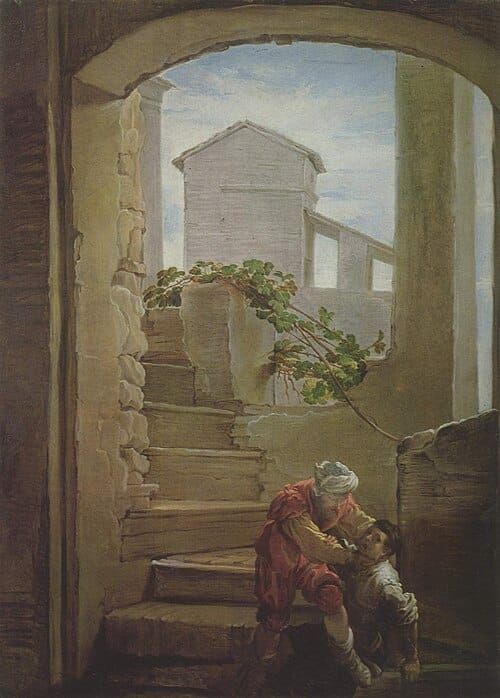
The parable that follows is an exercise in proportion. Ten thousand talents set against a hundred denarii — a sum no lifetime could repay, set beside a sum a week's wages would cover. The servant's failure is not that he forgot what he owed; it is that he never grasped what had been done for him. He walked out of that audience chamber a free man and did not know it. Having received a mercy without measure, he went out into the courtyard and began, immediately, to measure.
Here the lesson presses upon the individual soul, and it is not comfortable. The unforgiving heart injures itself first and most. "We punish ourselves by hating others, even as on the other hand we benefit ourselves by loving them," wrote the great preacher of Antioch, who saw that vengeance is a sword thrust inward. The offense done to us passes; the grudge we keep remains, and it remains in us. We are not the jailers of our debtors. We are their fellow prisoners, and we have turned the key upon ourselves.
There is a graver consequence still, which the Church states without softening: "this outpouring of mercy cannot penetrate our hearts as long as we have not forgiven those who have trespassed against us." It is not that God withholds. It is that the closed hand cannot receive. The soul that will not open toward its brother has, by that very refusal, made itself impervious to the Father, and the mercy it begs for waits at a door bolted from within. The words said daily in the Lord's Prayer are no description of what we hope God will do; they are a condition we ourselves have set, for we cannot demand God's forgiveness for ourselves if we in turn do not grant forgiveness to our neighbour.
Yet forgiveness, rightly understood, is a smaller and a greater thing than we imagine. It is not a feeling summoned up, nor a verdict that the wound did not matter, nor an act of forgetting, which is not in our power at all. "It is not in our power not to feel or to forget an offense; but the heart that offers itself to the Holy Spirit turns injury into compassion and purifies the memory in transforming the hurt into intercession." That is the whole labour, and it is the labour of days and sometimes of years: to take the name that rises with such heat and to set it, deliberately, inside a prayer. The memory is not erased. It is converted.
This is why the Church will not let the soul come to the altar with a quarrel still in its hands. "God can be appeased only by prayers that make peace," said the bishop of Carthage. And none of us, as the Apostle reminds us today, lives for himself or dies for himself; whether we live or die, we are the Lord's, and what is done with the one who has wronged us is done within His household and under His eye.
The beginning of all this is not effort but wonder: to stand still long enough to see the size of the debt already cancelled. As far as the east is from the west, so far has He put our transgressions from us — not measured, not remembered, not held against us. A soul that has truly looked at that will find the hundred denarii in its own keeping grow strangely light. Forgiveness given is never the invention of a generosity we do not possess; it is only the overflow of one already received. And it bears a witness the world cannot easily dismiss, that love is stronger than sin.
Lord, You have forgiven me a debt I could not name and could never have paid. Teach me to look long at that mercy, until my own grievances grow small within me. Where I cannot yet forget, let me intercede; where the wound still burns, turn it into compassion. Through Christ our Lord. Amen.
Sources & References
- "Wrath and anger are hateful things, yet the sinner hugs them tight." — Sirach 27:30 (First Reading: Sirach 27:30—28:7)
- "As far as the east is from the west, so far has he put our transgressions from us." — Psalm 103:12 (Responsorial Psalm: Ps 103:1-2, 3-4, 9-10, 11-12)
- "Whether we live or die, we are the Lord's." — Romans 14:8 (Second Reading: Romans 14:7-9)
- "Not seven times but seventy-seven times." — Matthew 18:22 (Gospel: Matthew 18:21-35)
- "We punish ourselves by hating others, even as on the other hand we benefit ourselves by loving them." — St. John Chrysostom, Homily 61 on Matthew, 5
- "This outpouring of mercy cannot penetrate our hearts as long as we have not forgiven those who have trespassed against us." — Catechism of the Catholic Church, 2840
- "It is not in our power not to feel or to forget an offense; but the heart that offers itself to the Holy Spirit turns injury into compassion and purifies the memory in transforming the hurt into intercession." — Catechism of the Catholic Church, 2843
- "God can be appeased only by prayers that make peace." — St. Cyprian of Carthage, De dominica oratione 23, cited in Catechism of the Catholic Church, 2845
- "Love is stronger than sin." — Catechism of the Catholic Church, 2844
- "We cannot demand God's forgiveness for ourselves if we in turn do not grant forgiveness to our neighbour." — Pope Francis, Angelus, 13 September 2020
- Readings: USCCB, Daily Readings for September 13, 2026
La deuda impagable y la mano que se abre
📖 Sagrada Escritura Diaria
Domingo 13 de septiembre de 2026 — XXIV Domingo Ordinario
Lecturas: Sirácida 27, 33—28, 9 • Salmo 102, 1-2. 3-4. 9-10. 11-12 • Romanos 14, 7-9 • Mateo 18, 21-35
"Cosas abominables son el rencor y la cólera; sin embargo, el pecador se aferra a ellas." La sabiduría del Sirácida se abre hoy con una frase que no acusa tanto como describe, y la descripción duele más por su exactitud. El agravio no es un peso impuesto al alma contra su voluntad; es una posesión, guardada, abrigada, defendida. El alma no suele llevar el rencor porque no pueda soltarlo, sino porque ha hallado en llevarlo una dulzura amarga: el placer de tener razón, la callada dignidad del herido, la pequeña soberanía de conservar en su poder la falta ajena.
En medio de esa complacencia cae la pregunta de Pedro, generosa según la medida de su tiempo: ¿hasta siete veces? Él suponía estar proponiendo algo magnánimo. La respuesta no eleva el número: suprime del todo la cuenta. Setenta veces siete no es un techo más alto, sino el fin de los techos, y con él el fin de aquel libro de cuentas que el alma lleva con tanta fidelidad, donde cada ofensa queda asentada y cada asiento se conserva para un futuro día de ajuste.
La parábola que sigue es un ejercicio de proporción. Muchos talentos frente a un poco de dinero: una suma que ninguna vida bastaría para saldar, puesta junto a otra que el jornal de una semana cubriría. La falta de aquel servidor no consiste en haber olvidado lo que debía, sino en no haber comprendido jamás lo que se había hecho con él. Salió de aquella sala como hombre libre y no lo advirtió. Habiendo recibido una misericordia sin medida, salió al patio y empezó, de inmediato, a medir.
Aquí la lección se vuelve apremiante para cada alma, y no es cómoda. El corazón que no perdona se hiere a sí mismo primero y más hondo. "Nos castigamos a nosotros mismos al odiar a los demás, así como, por el contrario, nos beneficiamos al amarlos", escribió el gran predicador de Antioquía, que vio en la venganza una espada vuelta hacia dentro. La ofensa recibida pasa; el rencor que guardamos permanece, y permanece en nosotros. No somos los carceleros de nuestros deudores: somos sus compañeros de prisión, y hemos dado vuelta a la llave sobre nosotros mismos.
Hay todavía una consecuencia más grave, que la Iglesia enuncia sin suavizarla: "este desbordamiento de misericordia no puede penetrar en nuestro corazón mientras no hayamos perdonado a los que nos han ofendido." No es que Dios se retenga. Es que la mano cerrada no puede recibir. El alma que se niega a abrirse hacia su hermano se ha hecho, por esa misma negativa, impermeable al Padre, y la misericordia que suplica aguarda ante una puerta cerrada por dentro. Las palabras que se rezan cada día en el Padrenuestro no describen lo que esperamos que Dios haga: son una condición que nosotros mismos hemos puesto, porque no podemos pretender para nosotros el perdón de Dios si nosotros, a nuestra vez, no concedemos el perdón a nuestro prójimo.
Y sin embargo, el perdón, bien entendido, es a la vez algo más pequeño y algo más grande de lo que imaginamos. No es un sentimiento que se convoca, ni un veredicto de que la herida no importó, ni un acto de olvido, que no está en nuestro poder. "No está en nuestra mano no sentir ya la ofensa y olvidarla; pero el corazón que se ofrece al Espíritu Santo cambia la herida en compasión y purifica la memoria transformando la ofensa en intercesión." Ése es todo el trabajo, y es trabajo de días y a veces de años: tomar el nombre que sube con tanto ardor y colocarlo, deliberadamente, dentro de una oración. La memoria no se borra. Se convierte.
Por eso la Iglesia no consiente que el alma se acerque al altar con una disputa todavía en las manos. "Dios quiere ser pacificado con oraciones de paz", decía el obispo de Cartago. Y ninguno de nosotros, como nos recuerda hoy el Apóstol, vive para sí mismo ni muere para sí mismo; ya sea que estemos vivos o que hayamos muerto, somos del Señor, y lo que se hace con quien nos ha ofendido se hace dentro de su casa y bajo su mirada.
El comienzo de todo esto no es el esfuerzo, sino el asombro: detenerse el tiempo suficiente para ver el tamaño de la deuda ya cancelada. El Señor no nos trata como merecen nuestras culpas, ni nos paga según nuestros pecados; no lleva la cuenta, no la guarda, no la esgrime contra nosotros. El alma que haya mirado de verdad eso hallará que la pequeña deuda que retiene se vuelve extrañamente ligera. El perdón que damos nunca es la invención de una generosidad que no poseemos: es sólo el desbordamiento de una que ya hemos recibido. Y da un testimonio que el mundo no puede desestimar fácilmente: que el amor es más fuerte que el pecado.
Señor, tú me has perdonado una deuda que no sabría nombrar y que jamás habría podido pagar. Enséñame a contemplar largamente esa misericordia, hasta que mis propios rencores se vuelvan pequeños dentro de mí. Donde todavía no puedo olvidar, concédeme interceder; donde la herida aún arde, conviértela en compasión. Por Jesucristo nuestro Señor. Amén.
Fuentes y referencias
- "Cosas abominables son el rencor y la cólera; sin embargo, el pecador se aferra a ellas." — Sirácida 27, 33 (Primera lectura: Sirácida 27, 33—28, 9)
- "No nos trata como merecen nuestras culpas, ni nos paga según nuestros pecados." — Salmo 102, 10 (Salmo responsorial: Sal 102, 1-2. 3-4. 9-10. 11-12)
- "Ya sea que estemos vivos o que hayamos muerto, somos del Señor." — Romanos 14, 8 (Segunda lectura: Romanos 14, 7-9)
- "No sólo hasta siete, sino hasta setenta veces siete." — Mateo 18, 22 (Evangelio: Mateo 18, 21-35)
- "Nos castigamos a nosotros mismos al odiar a los demás, así como, por el contrario, nos beneficiamos al amarlos." — San Juan Crisóstomo, Homilía 61 sobre San Mateo, 5
- "Este desbordamiento de misericordia no puede penetrar en nuestro corazón mientras no hayamos perdonado a los que nos han ofendido." — Catecismo de la Iglesia Católica, 2840
- "No está en nuestra mano no sentir ya la ofensa y olvidarla; pero el corazón que se ofrece al Espíritu Santo cambia la herida en compasión y purifica la memoria transformando la ofensa en intercesión." — Catecismo de la Iglesia Católica, 2843
- "Dios quiere ser pacificado con oraciones de paz." — San Cipriano de Cartago, De dominica Oratione 23, citado en el Catecismo de la Iglesia Católica, 2845
- "El amor es más fuerte que el pecado." — Catecismo de la Iglesia Católica, 2844
- "No podemos pretender para nosotros el perdón de Dios, si nosotros, a nuestra vez, no concedemos el perdón a nuestro prójimo." — Papa Francisco, Ángelus, 13 de septiembre de 2020
- Lecturas: USCCB, Lecturas del 13 de septiembre de 2026