
📖 Daily Scripture
Sunday, August 9, 2026 — Nineteenth Sunday in Ordinary Time
Readings: 1 Kings 19:9a, 11-13a • Psalm 85:9, 10, 11-12, 13-14 • Romans 9:1-5 • Matthew 14:22-33
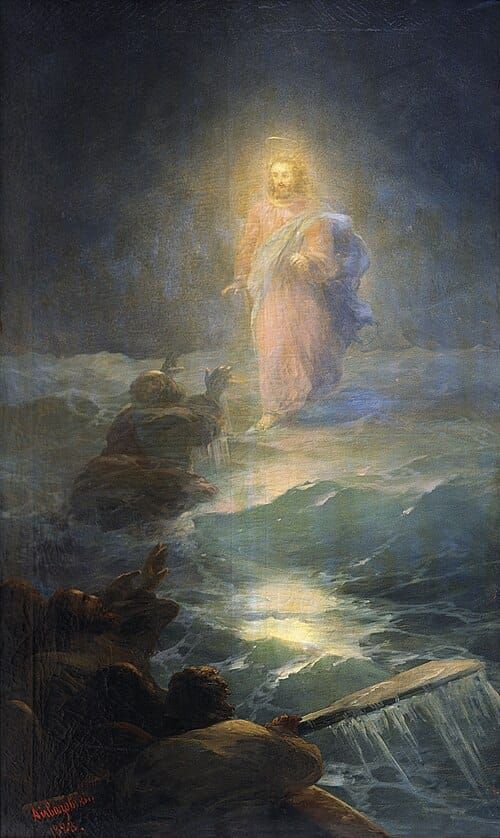
There are two waters in today's liturgy, and upon both of them God passes by. On Horeb the prophet stands at the mouth of his cave while a strong and heavy wind rends the mountains, while the earth quakes and fire runs before the Lord; and the Lord is in none of these. Then comes a tiny whispering sound, and at that whisper — not at the tempest — Elijah hides his face in his cloak. On the lake of Galilee, centuries later, the disciples labor at the oars through the fourth watch of the night, the wind against them, the waves tossing the boat; and He who had gone up the mountain alone to pray comes toward them walking upon the very element they fear.
The soul is slow to learn what these two scenes teach together. It looks for God in what is great, sudden, and overpowering; it supposes that if He were truly near, He would announce Himself unmistakably, silencing every doubt by force. But He is pleased, for the most part, to come quietly, so that only the attentive heart perceives Him. St. Cyprian, writing on prayer in an age of persecution, says simply, "God is the hearer, not of the voice, but of the heart." And the Catechism teaches that "contemplative prayer is silence, the 'symbol of the world to come' or 'silent love.'" A soul that is never still, never withdrawn from the noise it both suffers and secretly loves, will scarcely hear the whisper by which God chooses to be known.
Yet stillness is only half the lesson; the other half is learned upon the water. Peter walks toward Christ so long as his eyes rest upon Christ; the deep bears him up as though it were pavement. The moment he turns to measure the strength of the wind, he begins to sink. Faith rarely fails all at once; it fails by a shifting of attention, a gradual transfer of the gaze from the One who commands to the circumstances that threaten. The Catechism does not conceal this trial from us: "Faith can be put to the test. The world we live in often seems very far from the one promised us by faith." The wind is real; the waves are real; the Gospel never pretends otherwise. What it denies is that they deserve the soul's attention more than Christ does.
And see how mercy outruns weakness. "Lord, save me!" — three words, prayed while sinking, and "immediately Jesus stretched out his hand and caught" him. There was no delay for reproach; the rebuke, "O you of little faith, why did you doubt?", comes after the rescue, spoken by a hand that has already closed upon its child. The Catechism observes that Jesus is saddened by the "little faith" of his own disciples, even as he marvels at the great faith of the centurion and the Canaanite woman; sadness, not rejection, is His response to our wavering. Pope Francis, meditating on this very Gospel, counsels two movements for the soul in darkness: call on Jesus, and welcome Jesus — for "at the worst moments, in the darkest of storms," He comes to meet us, "asking to be welcomed like that night on the lake."
The moral lesson, then, is a discipline of attention. To make each day a small Horeb — some interval of true silence in which the heart listens rather than speaks — is not a luxury of the devout but the ordinary condition of hearing God at all. And when the storm rises, as it will — illness, loss, fear for those we love, the long contrary wind of ordinary duty — the soul must not negotiate with the wind. It must look at Christ and speak His name, briefly if it can manage nothing more, for the shortest prayer of a sinking man was heard at once. St. Augustine confessed for every one of us, "You have made us for yourself, O Lord, and our heart is restless until it rests in you." That rest is not the absence of storms but the presence of the One who walks upon them. The psalm gives the soul its horizon: kindness and truth shall meet; justice and peace shall kiss. The storm has never yet had the last word; the whisper has.
Lord Jesus, teach me to listen for the whisper beneath the wind, and to keep my eyes upon You when the waves rise within me. When I begin to sink, put into my mouth the prayer of Peter, and stretch out Your hand before fear can close over my head. Make in my heart a quiet place where You may speak, and let Your kindness and truth meet within me. Through Christ our Lord. Amen.
Sources & References
- "the LORD was not in the wind … a tiny whispering sound" — 1 Kings 19:9a, 11-13a (Lectionary, USCCB Daily Readings, August 9, 2026)
- "Kindness and truth shall meet; justice and peace shall kiss" — Psalm 85:11 (Responsorial Psalm, Psalm 85:9, 10, 11-12, 13-14)
- Second Reading — Romans 9:1-5
- "Take courage, it is I; do not be afraid." / "Lord, save me!" / "O you of little faith, why did you doubt?" — Matthew 14:22-33
- "God is the hearer, not of the voice, but of the heart." — St. Cyprian of Carthage, On the Lord's Prayer, 4
- "You have made us for yourself, O Lord, and our heart is restless until it rests in you." — St. Augustine, Confessions I, 1
- "Contemplative prayer is silence, the 'symbol of the world to come' or 'silent love.'" — Catechism of the Catholic Church, 2717
- "Faith can be put to the test. The world we live in often seems very far from the one promised us by faith." — Catechism of the Catholic Church, 164
- On the "little faith" of the disciples and the great faith of the centurion and the Canaanite woman — Catechism of the Catholic Church, 2610
- "call on Jesus and welcome Jesus … at the worst moments, in the darkest of storms" — Pope Francis, Angelus, 13 August 2023 (via Vatican News, Word of the Day, 9 August 2026)
El murmullo y la ola
📖 Sagrada Escritura Diaria
Domingo 9 de agosto de 2026 — XIX Domingo Ordinario
Lecturas: 1 Reyes 19, 9a. 11-13a • Salmo 84, 9ab-10. 11-12. 13-14 • Romanos 9, 1-5 • Mateo 14, 22-33
Hay dos aguas en la liturgia de hoy, y sobre ambas pasa Dios. En el Horeb, el profeta está a la entrada de su cueva mientras un viento huracanado parte las montañas, mientras tiembla la tierra y el fuego corre delante del Señor; y el Señor no está en ninguno de ellos. Entonces se escucha el murmullo de una brisa suave, y ante ese murmullo — no ante la tempestad — Elías se cubre el rostro con el manto. En el lago de Galilea, siglos después, los discípulos reman durante la madrugada, con el viento contrario y las olas sacudiendo la barca; y Aquel que había subido al monte a solas para orar viene hacia ellos caminando sobre el mismo elemento que ellos temen.
El alma tarda en aprender lo que estas dos escenas enseñan juntas. Busca a Dios en lo grande, lo repentino y lo imponente; supone que, si Él estuviera verdaderamente cerca, se anunciaría de modo inconfundible, silenciando toda duda por la fuerza. Pero a Él le agrada, casi siempre, venir en silencio, de modo que solo el corazón atento lo percibe. San Cipriano, escribiendo sobre la oración en tiempos de persecución, dice sencillamente: "Dios no escucha la voz, sino el corazón". Y el Catecismo enseña que "la oración contemplativa es silencio", ese "símbolo del mundo venidero", ese "silencioso amor". Un alma que nunca está quieta, que nunca se retira del ruido que a la vez padece y secretamente ama, difícilmente oirá el murmullo por el cual Dios quiere darse a conocer.
Pero la quietud es solo la mitad de la lección; la otra mitad se aprende sobre el agua. Pedro camina hacia Cristo mientras sus ojos descansan en Cristo; el abismo lo sostiene como si fuera pavimento. En el momento en que se vuelve a medir la fuerza del viento, comienza a hundirse. La fe rara vez falla de golpe; falla por un desplazamiento de la atención, un traslado gradual de la mirada desde Aquel que manda hacia las circunstancias que amenazan. El Catecismo no nos oculta esta prueba: "La fe puede ser puesta a prueba. El mundo en que vivimos parece con frecuencia muy lejos de lo que la fe nos asegura". El viento es real; las olas son reales; el Evangelio nunca finge lo contrario. Lo que niega es que merezcan la atención del alma más que Cristo.
Y mírese cómo la misericordia corre más rápido que la debilidad. "¡Sálvame, Señor!" — tres palabras, rezadas mientras se hunde, e inmediatamente Jesús le tendió la mano y lo sostuvo. No hubo demora para el reproche; la reprensión, "Hombre de poca fe, ¿por qué dudaste?", llega después del rescate, pronunciada por una mano que ya se ha cerrado sobre su hijo. El Catecismo observa que Jesús se entristece por la "poca fe" de sus propios discípulos, aun cuando se maravilla ante la gran fe del centurión y de la cananea; tristeza, no rechazo, es su respuesta a nuestra vacilación. El Papa Francisco, meditando sobre este mismo Evangelio, aconseja dos movimientos para el alma en la oscuridad: invocar a Jesús y acoger a Jesús — porque en los peores momentos, en las tormentas más oscuras, Él viene a nuestro encuentro, pidiendo ser acogido como aquella noche en el lago.
La lección moral, entonces, es una disciplina de la atención. Hacer de cada día un pequeño Horeb — algún intervalo de verdadero silencio en el que el corazón escuche en vez de hablar — no es un lujo de los devotos, sino la condición ordinaria para oír a Dios en absoluto. Y cuando se levante la tormenta, como se levantará — la enfermedad, la pérdida, el temor por los que amamos, el largo viento contrario del deber cotidiano — el alma no debe negociar con el viento. Debe mirar a Cristo y pronunciar su nombre, brevemente si no puede más, porque la oración más corta de un hombre que se hundía fue escuchada al instante. San Agustín confesó por cada uno de nosotros: "Nos hiciste, Señor, para ti, y nuestro corazón está inquieto hasta que descanse en ti". Ese descanso no es la ausencia de tormentas, sino la presencia de Aquel que camina sobre ellas. El salmo le da al alma su horizonte: la misericordia y la verdad se encontraron, la justicia y la paz se besaron. La tormenta nunca ha tenido la última palabra; el murmullo, sí.
Señor Jesús, enséñame a escuchar el murmullo debajo del viento, y a mantener mis ojos en Ti cuando las olas se levanten dentro de mí. Cuando comience a hundirme, pon en mi boca la oración de Pedro, y extiende tu mano antes de que el miedo se cierre sobre mi cabeza. Haz en mi corazón un lugar silencioso donde puedas hablar, y que tu misericordia y tu verdad se encuentren dentro de mí. Por Jesucristo nuestro Señor. Amén.
Fuentes y referencias
- "pero el Señor no estaba en el viento … el murmullo de una brisa suave" — 1 Reyes 19, 9a. 11-13a (Leccionario, USCCB Lecturas Diarias, 9 de agosto de 2026)
- "La misericordia y la verdad se encontraron, la justicia y la paz se besaron" — Salmo 84, 11 (Salmo Responsorial, Salmo 84, 9ab-10. 11-12. 13-14)
- Segunda lectura — Romanos 9, 1-5
- "Tranquilícense y no teman. Soy yo." / "¡Sálvame, Señor!" / "Hombre de poca fe, ¿por qué dudaste?" — Mateo 14, 22-33
- "Dios no escucha la voz, sino el corazón." — San Cipriano de Cartago, Sobre la oración del Señor, 4
- "Nos hiciste, Señor, para ti, y nuestro corazón está inquieto hasta que descanse en ti." — San Agustín, Confesiones I, 1
- "La oración contemplativa es silencio" — Catecismo de la Iglesia Católica, 2717
- "La fe puede ser puesta a prueba. El mundo en que vivimos parece con frecuencia muy lejos de lo que la fe nos asegura." — Catecismo de la Iglesia Católica, 164
- Sobre la "poca fe" de los discípulos y la gran fe del centurión y de la cananea — Catecismo de la Iglesia Católica, 2610
- Invocar a Jesús y acoger a Jesús — Papa Francisco, Ángelus, 13 de agosto de 2023 (vía Vatican News, Palabra del día, 9 de agosto de 2026)